# Copyright (C) 2002-2004 gregoire HUBERT.
#
# This library is free software; you can redistribute it and/or
# modify it under the terms of the GNU Lesser General Public
# License as published by the Free Software Foundation; either
# version 2.1 of the License, or (at your option) any later version.
#
# This library is distributed in the hope that it will be useful,
# but WITHOUT ANY WARRANTY; without even the implied warranty of
# MERCHANTABILITY or FITNESS FOR A PARTICULAR PURPOSE. See the GNU
# Lesser General Public License for more details.
#
# You should have received a copy of the GNU Lesser General Public
# License along with this library; if not, write to the Free Software
# Foundation, Inc., 59 Temple Place, Suite 330, Boston, MA 02111-1307 USA
#
# Author : gregoire HUBERT
#
# XML_node.objet
#
# This object is an XML node representation
#
# /- name (string)
# xml_node --- attributes (array)
# \- children (array) or value (string)
class xml_node {
var $name;
var $attributes = array();
var $children = array();
var $value = "";
function xml_node($name,$attributes,$children=array(),$value="") {
$this->name = $name;
if (is_array($attributes)) {
$this->attributes = $attributes;
}
$this->children = $children;
$this->value = $value;
}
}
# Copyright (C) 2003-2004 gregoire HUBERT.
#
# This library is free software; you can redistribute it and/or
# modify it under the terms of the GNU Lesser General Public
# License as published by the Free Software Foundation; either
# version 2.1 of the License, or (at your option) any later version.
#
# This library is distributed in the hope that it will be useful,
# but WITHOUT ANY WARRANTY; without even the implied warranty of
# MERCHANTABILITY or FITNESS FOR A PARTICULAR PURPOSE. See the GNU
# Lesser General Public License for more details.
#
# You should have received a copy of the GNU Lesser General Public
# License along with this library; if not, write to the Free Software
# Foundation, Inc., 59 Temple Place, Suite 330, Boston, MA 02111-1307 USA
#
# Author : gregoire HUBERT
#
# xml_tree class
#
# This object parses an XML stream and offers a tree composed by xml_nodes
#
class xml_tree {
var $xml_stream;
var $current_node;
var $root_node;
var $index;
var $value;
function xml_tree() {
$this->root_node = new xml_node("__ROOT_NODE",array());
$this->current_node = $this->root_node;
}
function add_tree($xml_stream) {
# Managing the parser
$this->xml_stream = $xml_stream;
$xml_parser = xml_parser_create();
xml_parser_set_option($xml_parser,XML_OPTION_CASE_FOLDING,0);
xml_parser_set_option($xml_parser,XML_OPTION_SKIP_WHITE,1);
if (!xml_parse_into_struct($xml_parser,$this->xml_stream,$this->value,$this->index)) {
xml_parser_free($xml_parser);
die("XML Parse error");
}
xml_parser_free($xml_parser);
# Now, $this->value and $this->index are informed, we can use the get_node methode.
$tab_result = $this->get_node(0,count($this->value) - 1);
$this->root_node->children[] = $tab_result[0];
$this->current_node = $this->root_node;
}
function get_node($index_start,$index_stop) {
#echo " \n";
#echo "GET-NODE($index_start,$index_stop) \n";
# What we are going to return is an array of xml_nodes
$return_tab = array();
# depth is only here to check if everything is all right
$tab_node = $this->value[$index_start];
$depth = $tab_node["level"]-1;
# Now we have to be sure we do not forget a single node
for ($index = $index_start;$index <= $index_stop;$index++) {
#echo "\$index = $index ";
# get the current node
$tab_node = $this->value[$index];
# what type of node is it ?
switch($tab_node["type"]) {
case "complete" :
# Depth integrity check
if ($tab_node["level"] != $depth+1) {
die("ERREUR # contrainte d'intégrité au noeud complet $index, niveau $depth + 1 au lieu de ".$tab_node["level"]);
}
#echo "Noeud complet trouvé position $index TAG ".$tab_node["tag"]." \n";
# Easy one, no children to manage, only a value...
$return_tab[] = new xml_node($tab_node["tag"],$tab_node["attributes"],"",$tab_node["value"]);
break;
case "open" :
# Depth integrity check
if ($tab_node["level"] != $depth +1 ) {
die("ERREUR # contrainte d'intégrité au noeud ouvert $index, niveau $depth au lieu de ".$tab_node["level"]);
}
# Open tag, we re-use this methode to return its children
# Where is the correspondong close tag ?
$node_index = $this->index[$tab_node["tag"]];
$flipped_node_index = array_flip($node_index);
#echo "This ".$tab_node["tag"]." is at coords ".$flipped_node_index[$index]." ";
$i=1;
do {
$next_index = $node_index[$flipped_node_index[$index] + $i++];
$next_tag=$this->value[$next_index];
}
while ($next_tag["level"]!=$tab_node["level"]);
#echo "Ouverture de noeud détectée pos $index TAG ".$tab_node["tag"]." \n Parcours jusqu au $next_index \n";
# good, we can now instanciate our node
$return_tab[] = new xml_node($tab_node["tag"],$tab_node["attributes"],$this->get_node($index+1,$next_index),"");
# As we called the get_node methode, we are sure that nodes have been parsed to the corresponding close tag
$index = $next_index;
break;
case "close" :
# Depth integrity check
if ($tab_node["level"] != $depth ){
die("ERREUR # contrainte d'intégrité au noeud fermé $index, niveau $depth au lieu de ".$tab_node["level"]);
}
#echo "Fermeture de noeud detectée pos $index TAG ".$tab_node["tag"]."
\n";
# This ugly thing is useless because reaching a close tag means that $index==$index_stop but who knows ? =)
# it will be skipped soon
$index = $index_stop;
break;
default:
die("Erreur de type de TAG non déterminé :'".$tab_node["type"]."'");
}
}
# We are out ... returns the array with collected children...
return ($return_tab);
}
# this function browse the xml tree and set the current node to the selected node
function give_node($path) {
if ($path[0]=="/") {
$current_node=$this->root_node;
$path=substr($path,1);
#echo "ABSOLUTE PATH GIVEN=$path ";
}
else {
$current_node = $this->current_node;
}
#echo "PATH GIVEN=$path ";
$tab_path = split("/",$path);
foreach ($tab_path as $node_expr) {
#echo "STUDYING EXPR='$node_expr' ";
$node = $current_node;
$expr_tab = split("\?",$node_expr);
$node_name = $expr_tab[0];
$attr_tab = 0;
if (count($expr_tab)>1) {
##echo "TROUVE AU MOINS UNE CONDITION SUR LES ATTRIBUTS... ";
$attr_expr_tab=split(",",$expr_tab[1]);
$attr_tab=array();
foreach($attr_expr_tab as $attr_expr) {
$attr_split_expr=split("=",$attr_expr);
$attr_tab[$attr_split_expr[0]]=$attr_split_expr[1];
}
}
$last=0;
foreach ($node->children as $children) {
#echo "COMPARING WITH '$children->name' ";
if ($children->name == $node_name) {
##echo "TROUVE NOEUD CORRESPONDANT $node_name ";
if (is_array($attr_tab)) {
$node_attributes = $children->attributes;
foreach ($attr_tab as $key=>$value) {
if ($node_attributes[$key] == $value) {
#echo "ATTRIBUTE & CHANGE CURRENT NODE TO ".$children->name." ";
$current_node = $children;
$last = 1;
}
}
}
else {
##echo "CHILD=".$children->name." ";
#echo "CHANGE CURRENT NODE TO ".$children->name." ";
$current_node = $children;
$last=1;
}
}
if ($last) {
break;
}
}
if (!$last) {
#echo "PATH ERROR $node_name ";
#die("MMmmmh It seems that this file is not a DIA XML format...sorry...");
return 0;
}
}
return $current_node;
}
function browse_tree($path) {
$node = $this->give_node($path);
if (is_object($node)) {
$this->current_node = $node;
return 1;
}
return 0;
}
# this method dumps an html representation of the xml tree
function xml_show($node = "",$level=0,$last=0) {
if ($node=="") {
$node=$this->root_node;
}
if (!is_object($node)) {
die("ERROR : node is not an object");
}
$line="";
for($i=1;$i<=$level;$i++) {
if ((i==$level-1) and ($last)) {
$line.=" ";
}
else {
$line.=" |";
}
if ($i==$level) {
$line.="`-";
}
}
$line.=$node->name;
#echo $line;
$line.="".count($node->children)."";
if (count($node->children)==1) {
$line.=" (".$node->value.") \n";
echo "$line";
}
else {
$line.=" \n";
echo "$line";
$i=1;
foreach($node->children as $children) {
if ($i==count($node->children)) {
$this->xml_show($children,$level+1,1);
}
else {
$this->xml_show($children,$level+1);
}
$i++;
}
}
}
#END_CLASS
}
LOITS (ee) - Vere Kutse Kohustab (2004)
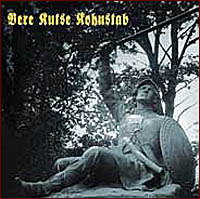
Label : Ledo Takas Records / Import
Sortie du Scud : 20 octobre 2004
Pays : Estonie
Genre : Heathen Black Metal
Type : Album
Playtime : 12 Titres - 55 Mins
C’est au terme de huit mois de préparation intense que Vere Kutse Kohustab est présenté comme l’album qui est censé asseoir LOITS comme une des locomotive dans le milieu du Heathen Black Metal. Au vu de ce travail de longue haleine, on comprend mieux ! Seconde sortie studio de ces Metalleux venus d’Estonie, ce quintette administre une combinaison originale de Black Metal à une dose d’héritage du Folklore national avec un esprit résolument Rock’n’Roll. Avec des paroles exclusivement en Estonien, ceux-ci achèvent une œuvre personnelle à la gloire de leur Patrie. En effet, une bonne fois pour toutes, LOITS veut en finir avec les clichés sur leur pays, notamment une de ces idées reçues est celle qui faisait de l’Estonie un allié de la Wehrmacht lors de la Seconde Guerre Mondiale. Blessés par cette pensée, les membres de LOITS ont à cœur de rétablir l’Histoire dans son contexte. On y apprendra que pour combattre le Communisme de l’Union Soviétique voisine, les Estoniens n’avaient pas d’autre alternative que de s’engager dans l’armée Germanique pour contrer les velléités d’annexion Russe. Leurs combats sous les uniformes Allemands étaient donc une nécessité historique. Il faut comprendre ces paramètres pour entrer dans le projet de LOITS.
Fiers de leur passé et de leur Histoire, LOITS chante les louanges de la Nation au travers de ces douze titres de Black’nRoll. L’album est si dense qu’il nécessitera plusieurs écoutes pour s’immerger dans ces compositions, car avec près d’une heure de Black’nRoll, il faut ingurgiter ce Vere Kutse Kohustab. Le chant en Estonien se fond avec les compositions de Mr Divine et les siens et ne choque pas outre mesure (heureusement qu’une traduction dans la langue de Shakespeare accompagne chacun des textes !).
L’apport de claviers perpétrés par Karje avec parcimonie (la présence féminine du combo Balte) est soigné et discret, le tout en étant efficace, à l’image du morceau « Tuleristsed ». On sent un travail énorme de recherche dans les arrangements comme peut l’illustrer « Vanade Legionaride Laul ». Les rythmiques privilégient les mid-tempos, telle sera la couleur musicale que l’on retrouve tout au long de opus. Un album qui regorge de pépites Black’n’Roll telles que « Aeg Argata », « Eluruun », « Kodu » ou « Furor Aesticus ». L’excellent travail de production ne vient que confirmer l’excellent boulot de LOITS, un son clair, direct. Au delà de çà, les Estoniens sont parvenus à se créer un son propre et un univers particulier.
Des titres moins « bons », faut relativiser, pour un groupe moyen se seraient des morceaux énormes, comme « Nimeta Haud ». Comme d’habitude, les produits proposés par Ledo Takas Records, qu’ils plaisent ou pas sont toujours des produits de qualité et bien réalisés, comme ce second album de LOITS, qui a dû faire parler de lui hors des frontières Estoniennes…
Ajouté : Mardi 25 Juillet 2006 Chroniqueur : Loki Score :     Lien en relation: Loits Website Hits: 21677
|