# Copyright (C) 2002-2004 gregoire HUBERT.
#
# This library is free software; you can redistribute it and/or
# modify it under the terms of the GNU Lesser General Public
# License as published by the Free Software Foundation; either
# version 2.1 of the License, or (at your option) any later version.
#
# This library is distributed in the hope that it will be useful,
# but WITHOUT ANY WARRANTY; without even the implied warranty of
# MERCHANTABILITY or FITNESS FOR A PARTICULAR PURPOSE. See the GNU
# Lesser General Public License for more details.
#
# You should have received a copy of the GNU Lesser General Public
# License along with this library; if not, write to the Free Software
# Foundation, Inc., 59 Temple Place, Suite 330, Boston, MA 02111-1307 USA
#
# Author : gregoire HUBERT
#
# XML_node.objet
#
# This object is an XML node representation
#
# /- name (string)
# xml_node --- attributes (array)
# \- children (array) or value (string)
class xml_node {
var $name;
var $attributes = array();
var $children = array();
var $value = "";
function xml_node($name,$attributes,$children=array(),$value="") {
$this->name = $name;
if (is_array($attributes)) {
$this->attributes = $attributes;
}
$this->children = $children;
$this->value = $value;
}
}
# Copyright (C) 2003-2004 gregoire HUBERT.
#
# This library is free software; you can redistribute it and/or
# modify it under the terms of the GNU Lesser General Public
# License as published by the Free Software Foundation; either
# version 2.1 of the License, or (at your option) any later version.
#
# This library is distributed in the hope that it will be useful,
# but WITHOUT ANY WARRANTY; without even the implied warranty of
# MERCHANTABILITY or FITNESS FOR A PARTICULAR PURPOSE. See the GNU
# Lesser General Public License for more details.
#
# You should have received a copy of the GNU Lesser General Public
# License along with this library; if not, write to the Free Software
# Foundation, Inc., 59 Temple Place, Suite 330, Boston, MA 02111-1307 USA
#
# Author : gregoire HUBERT
#
# xml_tree class
#
# This object parses an XML stream and offers a tree composed by xml_nodes
#
class xml_tree {
var $xml_stream;
var $current_node;
var $root_node;
var $index;
var $value;
function xml_tree() {
$this->root_node = new xml_node("__ROOT_NODE",array());
$this->current_node = $this->root_node;
}
function add_tree($xml_stream) {
# Managing the parser
$this->xml_stream = $xml_stream;
$xml_parser = xml_parser_create();
xml_parser_set_option($xml_parser,XML_OPTION_CASE_FOLDING,0);
xml_parser_set_option($xml_parser,XML_OPTION_SKIP_WHITE,1);
if (!xml_parse_into_struct($xml_parser,$this->xml_stream,$this->value,$this->index)) {
xml_parser_free($xml_parser);
die("XML Parse error");
}
xml_parser_free($xml_parser);
# Now, $this->value and $this->index are informed, we can use the get_node methode.
$tab_result = $this->get_node(0,count($this->value) - 1);
$this->root_node->children[] = $tab_result[0];
$this->current_node = $this->root_node;
}
function get_node($index_start,$index_stop) {
#echo " \n";
#echo "GET-NODE($index_start,$index_stop) \n";
# What we are going to return is an array of xml_nodes
$return_tab = array();
# depth is only here to check if everything is all right
$tab_node = $this->value[$index_start];
$depth = $tab_node["level"]-1;
# Now we have to be sure we do not forget a single node
for ($index = $index_start;$index <= $index_stop;$index++) {
#echo "\$index = $index ";
# get the current node
$tab_node = $this->value[$index];
# what type of node is it ?
switch($tab_node["type"]) {
case "complete" :
# Depth integrity check
if ($tab_node["level"] != $depth+1) {
die("ERREUR # contrainte d'intégrité au noeud complet $index, niveau $depth + 1 au lieu de ".$tab_node["level"]);
}
#echo "Noeud complet trouvé position $index TAG ".$tab_node["tag"]." \n";
# Easy one, no children to manage, only a value...
$return_tab[] = new xml_node($tab_node["tag"],$tab_node["attributes"],"",$tab_node["value"]);
break;
case "open" :
# Depth integrity check
if ($tab_node["level"] != $depth +1 ) {
die("ERREUR # contrainte d'intégrité au noeud ouvert $index, niveau $depth au lieu de ".$tab_node["level"]);
}
# Open tag, we re-use this methode to return its children
# Where is the correspondong close tag ?
$node_index = $this->index[$tab_node["tag"]];
$flipped_node_index = array_flip($node_index);
#echo "This ".$tab_node["tag"]." is at coords ".$flipped_node_index[$index]." ";
$i=1;
do {
$next_index = $node_index[$flipped_node_index[$index] + $i++];
$next_tag=$this->value[$next_index];
}
while ($next_tag["level"]!=$tab_node["level"]);
#echo "Ouverture de noeud détectée pos $index TAG ".$tab_node["tag"]." \n Parcours jusqu au $next_index \n";
# good, we can now instanciate our node
$return_tab[] = new xml_node($tab_node["tag"],$tab_node["attributes"],$this->get_node($index+1,$next_index),"");
# As we called the get_node methode, we are sure that nodes have been parsed to the corresponding close tag
$index = $next_index;
break;
case "close" :
# Depth integrity check
if ($tab_node["level"] != $depth ){
die("ERREUR # contrainte d'intégrité au noeud fermé $index, niveau $depth au lieu de ".$tab_node["level"]);
}
#echo "Fermeture de noeud detectée pos $index TAG ".$tab_node["tag"]."
\n";
# This ugly thing is useless because reaching a close tag means that $index==$index_stop but who knows ? =)
# it will be skipped soon
$index = $index_stop;
break;
default:
die("Erreur de type de TAG non déterminé :'".$tab_node["type"]."'");
}
}
# We are out ... returns the array with collected children...
return ($return_tab);
}
# this function browse the xml tree and set the current node to the selected node
function give_node($path) {
if ($path[0]=="/") {
$current_node=$this->root_node;
$path=substr($path,1);
#echo "ABSOLUTE PATH GIVEN=$path ";
}
else {
$current_node = $this->current_node;
}
#echo "PATH GIVEN=$path ";
$tab_path = split("/",$path);
foreach ($tab_path as $node_expr) {
#echo "STUDYING EXPR='$node_expr' ";
$node = $current_node;
$expr_tab = split("\?",$node_expr);
$node_name = $expr_tab[0];
$attr_tab = 0;
if (count($expr_tab)>1) {
##echo "TROUVE AU MOINS UNE CONDITION SUR LES ATTRIBUTS... ";
$attr_expr_tab=split(",",$expr_tab[1]);
$attr_tab=array();
foreach($attr_expr_tab as $attr_expr) {
$attr_split_expr=split("=",$attr_expr);
$attr_tab[$attr_split_expr[0]]=$attr_split_expr[1];
}
}
$last=0;
foreach ($node->children as $children) {
#echo "COMPARING WITH '$children->name' ";
if ($children->name == $node_name) {
##echo "TROUVE NOEUD CORRESPONDANT $node_name ";
if (is_array($attr_tab)) {
$node_attributes = $children->attributes;
foreach ($attr_tab as $key=>$value) {
if ($node_attributes[$key] == $value) {
#echo "ATTRIBUTE & CHANGE CURRENT NODE TO ".$children->name." ";
$current_node = $children;
$last = 1;
}
}
}
else {
##echo "CHILD=".$children->name." ";
#echo "CHANGE CURRENT NODE TO ".$children->name." ";
$current_node = $children;
$last=1;
}
}
if ($last) {
break;
}
}
if (!$last) {
#echo "PATH ERROR $node_name ";
#die("MMmmmh It seems that this file is not a DIA XML format...sorry...");
return 0;
}
}
return $current_node;
}
function browse_tree($path) {
$node = $this->give_node($path);
if (is_object($node)) {
$this->current_node = $node;
return 1;
}
return 0;
}
# this method dumps an html representation of the xml tree
function xml_show($node = "",$level=0,$last=0) {
if ($node=="") {
$node=$this->root_node;
}
if (!is_object($node)) {
die("ERROR : node is not an object");
}
$line="";
for($i=1;$i<=$level;$i++) {
if ((i==$level-1) and ($last)) {
$line.=" ";
}
else {
$line.=" |";
}
if ($i==$level) {
$line.="`-";
}
}
$line.=$node->name;
#echo $line;
$line.="".count($node->children)."";
if (count($node->children)==1) {
$line.=" (".$node->value.") \n";
echo "$line";
}
else {
$line.=" \n";
echo "$line";
$i=1;
foreach($node->children as $children) {
if ($i==count($node->children)) {
$this->xml_show($children,$level+1,1);
}
else {
$this->xml_show($children,$level+1);
}
$i++;
}
}
}
#END_CLASS
}
MOTW (FRA/tn) - The Evil Twin (2012)
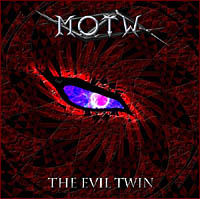
Label : Auto-Production
Sortie du Scud : 2011
Pays : France / Tunisie
Genre : Heavy Metal progressif
Type : Album
Playtime : 22 Titres - 111 Mins
MOTW alias MARK OF THE WOLVES est un groupe né des amours tumultueuses entre une bande geeks amateurs de bourre-pifs pixellisés et un gros joystick noir à 4 boutons. Voilà de quoi lui assurer un fort capital-sympathie auprès de votre serviteur, et donner à ce dernier l'envie d'en découdre lors d'un duel en 2 rounds, un par album. Car le groupe franco-tunisien semble décidé à frapper fort dès son premier combat en nous assénant d'emblée un double concept-album, exercice ô combien périlleux, auquel même les plus grands ne se risquent plus guère. Courageux certes, mais n'importe quel vieux maître en arts martiaux vous le dira: le courage seul ne suffit pas à faire un grand guerrier. Alors, MOTW s'est-il donné les moyens de ses ambitions? Fight!
Round one : Black Life
Il est question dans ce premier album, non pas de jeux vidéo mais des mésaventures d'un orphelin de guerre doté de pouvoirs surnaturels. Musicalement, c'est du Heavy Metal relativement classique à forte connotation prog'. Sur des rythmiques nerveuses, guitare solo et synthé se répondent lors de duels plutôt spectaculaires, notamment sur "kerozen" et "Khalimastra 5". Ca peut sembler daté, certains diront même ringard, mais c'est agréable à l'oreille. Le problème, car problème il y a, vient plutôt du chant : la voix très douce, presque androgyne, de Mr K manque singulièrement de hargne pour un album de Heavy. Sa tessiture parait limitée et son accent anglais laisse à désirer. A sa décharge, on précisera qu'il n'est vraiment pas aidé par une production trop lisse, abusant de la réverbération sur la voix et incapable de donner suffisamment d'épaisseur aux instruments (guitare rythmique en particulier). Les compos y perdent beaucoup de leur punch et cela crée une distance excessive entre l'auditeur et les musiciens. C'est d'autant plus dommage qu'on sent un réel potentiel, trop rarement exploité, en particulier sur "GBU 43B" un instrumental plus lourd et puissant que le reste de l'album.
Round two : White Death
Après cette première partie manquant de mordant, on pourrait craindre le pire quant au deuxième album annoncé comme plus symphonique. Effectivement, il fait la part belle aux synthés, désormais utilisés comme de vrais claviers et non comme une seconde guitare solo. Déjà bien étouffées par la production, les guitares se font encore plus discrètes. Les compos s'étirent davantage en longueur, jouant davantage la carte progressive pour nous proposer des visions hallucinatoires de la vie après la mort. Contre toute attente, ce White Death s'avère un peu plus abouti que son jumeau. Oh, bien sûr on n'échappe pas à quelques orchestrations clinquantes semblant tirées d'un téléfilm de SF vieux de 20 ans ni à une certaine grandiloquence indissociable du genre. Mais globalement, le ton plus posé de ce deuxième album sied mieux au groupe. Les défauts évoqués plus haut s'y font moins sentir, malgré quelques faux pas regrettables comme le final parlé (ou rappé?) de "The Tool" qui ruine un morceau par ailleurs réussi.
Game Over. Continue?
2 heures de musique plus tard, le constat, prévisible, s'impose : MOTW a voulu aller trop loin trop tôt. Le double album conceptuel est un exercice trop ambitieux pour un jeune groupe inexpérimenté. Il semble évident que le combo n'a pas pu consacrer autant de temps à la finition de ces 22 titres qu'il l'aurait fait avec les 5 ou 6 morceaux d'un EP. Le sens mélodique est bien là, ainsi que la volonté de proposer une oeuvre consistante au public; mais un effort de concision, de production et un gros travail sur le chant restent à faire. Tu n'es pas encore prêt, petit scarabée. Mais continue à t'entraîner, ça va venir!
Ajouté : Lundi 20 Février 2012 Chroniqueur : Cyco_Nico Score :    Lien en relation: MOTW Website Hits: 12498
|