# Copyright (C) 2002-2004 gregoire HUBERT.
#
# This library is free software; you can redistribute it and/or
# modify it under the terms of the GNU Lesser General Public
# License as published by the Free Software Foundation; either
# version 2.1 of the License, or (at your option) any later version.
#
# This library is distributed in the hope that it will be useful,
# but WITHOUT ANY WARRANTY; without even the implied warranty of
# MERCHANTABILITY or FITNESS FOR A PARTICULAR PURPOSE. See the GNU
# Lesser General Public License for more details.
#
# You should have received a copy of the GNU Lesser General Public
# License along with this library; if not, write to the Free Software
# Foundation, Inc., 59 Temple Place, Suite 330, Boston, MA 02111-1307 USA
#
# Author : gregoire HUBERT
#
# XML_node.objet
#
# This object is an XML node representation
#
# /- name (string)
# xml_node --- attributes (array)
# \- children (array) or value (string)
class xml_node {
var $name;
var $attributes = array();
var $children = array();
var $value = "";
function xml_node($name,$attributes,$children=array(),$value="") {
$this->name = $name;
if (is_array($attributes)) {
$this->attributes = $attributes;
}
$this->children = $children;
$this->value = $value;
}
}
# Copyright (C) 2003-2004 gregoire HUBERT.
#
# This library is free software; you can redistribute it and/or
# modify it under the terms of the GNU Lesser General Public
# License as published by the Free Software Foundation; either
# version 2.1 of the License, or (at your option) any later version.
#
# This library is distributed in the hope that it will be useful,
# but WITHOUT ANY WARRANTY; without even the implied warranty of
# MERCHANTABILITY or FITNESS FOR A PARTICULAR PURPOSE. See the GNU
# Lesser General Public License for more details.
#
# You should have received a copy of the GNU Lesser General Public
# License along with this library; if not, write to the Free Software
# Foundation, Inc., 59 Temple Place, Suite 330, Boston, MA 02111-1307 USA
#
# Author : gregoire HUBERT
#
# xml_tree class
#
# This object parses an XML stream and offers a tree composed by xml_nodes
#
class xml_tree {
var $xml_stream;
var $current_node;
var $root_node;
var $index;
var $value;
function xml_tree() {
$this->root_node = new xml_node("__ROOT_NODE",array());
$this->current_node = $this->root_node;
}
function add_tree($xml_stream) {
# Managing the parser
$this->xml_stream = $xml_stream;
$xml_parser = xml_parser_create();
xml_parser_set_option($xml_parser,XML_OPTION_CASE_FOLDING,0);
xml_parser_set_option($xml_parser,XML_OPTION_SKIP_WHITE,1);
if (!xml_parse_into_struct($xml_parser,$this->xml_stream,$this->value,$this->index)) {
xml_parser_free($xml_parser);
die("XML Parse error");
}
xml_parser_free($xml_parser);
# Now, $this->value and $this->index are informed, we can use the get_node methode.
$tab_result = $this->get_node(0,count($this->value) - 1);
$this->root_node->children[] = $tab_result[0];
$this->current_node = $this->root_node;
}
function get_node($index_start,$index_stop) {
#echo " \n";
#echo "GET-NODE($index_start,$index_stop) \n";
# What we are going to return is an array of xml_nodes
$return_tab = array();
# depth is only here to check if everything is all right
$tab_node = $this->value[$index_start];
$depth = $tab_node["level"]-1;
# Now we have to be sure we do not forget a single node
for ($index = $index_start;$index <= $index_stop;$index++) {
#echo "\$index = $index ";
# get the current node
$tab_node = $this->value[$index];
# what type of node is it ?
switch($tab_node["type"]) {
case "complete" :
# Depth integrity check
if ($tab_node["level"] != $depth+1) {
die("ERREUR # contrainte d'intégrité au noeud complet $index, niveau $depth + 1 au lieu de ".$tab_node["level"]);
}
#echo "Noeud complet trouvé position $index TAG ".$tab_node["tag"]." \n";
# Easy one, no children to manage, only a value...
$return_tab[] = new xml_node($tab_node["tag"],$tab_node["attributes"],"",$tab_node["value"]);
break;
case "open" :
# Depth integrity check
if ($tab_node["level"] != $depth +1 ) {
die("ERREUR # contrainte d'intégrité au noeud ouvert $index, niveau $depth au lieu de ".$tab_node["level"]);
}
# Open tag, we re-use this methode to return its children
# Where is the correspondong close tag ?
$node_index = $this->index[$tab_node["tag"]];
$flipped_node_index = array_flip($node_index);
#echo "This ".$tab_node["tag"]." is at coords ".$flipped_node_index[$index]." ";
$i=1;
do {
$next_index = $node_index[$flipped_node_index[$index] + $i++];
$next_tag=$this->value[$next_index];
}
while ($next_tag["level"]!=$tab_node["level"]);
#echo "Ouverture de noeud détectée pos $index TAG ".$tab_node["tag"]." \n Parcours jusqu au $next_index \n";
# good, we can now instanciate our node
$return_tab[] = new xml_node($tab_node["tag"],$tab_node["attributes"],$this->get_node($index+1,$next_index),"");
# As we called the get_node methode, we are sure that nodes have been parsed to the corresponding close tag
$index = $next_index;
break;
case "close" :
# Depth integrity check
if ($tab_node["level"] != $depth ){
die("ERREUR # contrainte d'intégrité au noeud fermé $index, niveau $depth au lieu de ".$tab_node["level"]);
}
#echo "Fermeture de noeud detectée pos $index TAG ".$tab_node["tag"]."
\n";
# This ugly thing is useless because reaching a close tag means that $index==$index_stop but who knows ? =)
# it will be skipped soon
$index = $index_stop;
break;
default:
die("Erreur de type de TAG non déterminé :'".$tab_node["type"]."'");
}
}
# We are out ... returns the array with collected children...
return ($return_tab);
}
# this function browse the xml tree and set the current node to the selected node
function give_node($path) {
if ($path[0]=="/") {
$current_node=$this->root_node;
$path=substr($path,1);
#echo "ABSOLUTE PATH GIVEN=$path ";
}
else {
$current_node = $this->current_node;
}
#echo "PATH GIVEN=$path ";
$tab_path = split("/",$path);
foreach ($tab_path as $node_expr) {
#echo "STUDYING EXPR='$node_expr' ";
$node = $current_node;
$expr_tab = split("\?",$node_expr);
$node_name = $expr_tab[0];
$attr_tab = 0;
if (count($expr_tab)>1) {
##echo "TROUVE AU MOINS UNE CONDITION SUR LES ATTRIBUTS... ";
$attr_expr_tab=split(",",$expr_tab[1]);
$attr_tab=array();
foreach($attr_expr_tab as $attr_expr) {
$attr_split_expr=split("=",$attr_expr);
$attr_tab[$attr_split_expr[0]]=$attr_split_expr[1];
}
}
$last=0;
foreach ($node->children as $children) {
#echo "COMPARING WITH '$children->name' ";
if ($children->name == $node_name) {
##echo "TROUVE NOEUD CORRESPONDANT $node_name ";
if (is_array($attr_tab)) {
$node_attributes = $children->attributes;
foreach ($attr_tab as $key=>$value) {
if ($node_attributes[$key] == $value) {
#echo "ATTRIBUTE & CHANGE CURRENT NODE TO ".$children->name." ";
$current_node = $children;
$last = 1;
}
}
}
else {
##echo "CHILD=".$children->name." ";
#echo "CHANGE CURRENT NODE TO ".$children->name." ";
$current_node = $children;
$last=1;
}
}
if ($last) {
break;
}
}
if (!$last) {
#echo "PATH ERROR $node_name ";
#die("MMmmmh It seems that this file is not a DIA XML format...sorry...");
return 0;
}
}
return $current_node;
}
function browse_tree($path) {
$node = $this->give_node($path);
if (is_object($node)) {
$this->current_node = $node;
return 1;
}
return 0;
}
# this method dumps an html representation of the xml tree
function xml_show($node = "",$level=0,$last=0) {
if ($node=="") {
$node=$this->root_node;
}
if (!is_object($node)) {
die("ERROR : node is not an object");
}
$line="";
for($i=1;$i<=$level;$i++) {
if ((i==$level-1) and ($last)) {
$line.=" ";
}
else {
$line.=" |";
}
if ($i==$level) {
$line.="`-";
}
}
$line.=$node->name;
#echo $line;
$line.="".count($node->children)."";
if (count($node->children)==1) {
$line.=" (".$node->value.") \n";
echo "$line";
}
else {
$line.=" \n";
echo "$line";
$i=1;
foreach($node->children as $children) {
if ($i==count($node->children)) {
$this->xml_show($children,$level+1,1);
}
else {
$this->xml_show($children,$level+1);
}
$i++;
}
}
}
#END_CLASS
}
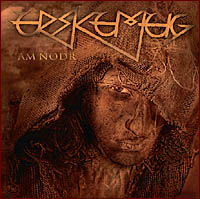
URSKUMUG (lv) - Am Nodr (2006)
Label : Ledo Takas Records / Import
Sortie du Scud : 30 avril 2006
Pays : Lettonie
Genre : Pagan Black Metal
Type : Album
Playtime : 8 Titres - 41 Mins
Originaires de Lettonie, les membres de URSKUMUG ont débuté leur carrière sous le patronyme de RAVEN en 2001 avant de changer de direction et de prendre un nom plus «local» et tribal en s’appelant URSKUMUG. A ses débuts, le quatuor Letton pratiquait un Black Metal atmosphérique, notamment avec l’utilisation de boites à rythmes, les batteries « classiques » ne trouvant pas grâce à leurs yeux. C’est ce que l’on pouvait trouver sur leur premier album auto-produit Pareja en 2003. Celui-ci reçut un très bon accueil dans leurs terres et en fit un des groupes les plus populaires de Metal en Lettonie, bien que le Metal n’y soit pas très représenté ou du moins populaire.
Signés chez le label Lituanien qui monte : Ledo Takas Records. Krauklis (guitares/voix), Slayorda (claviers) et leurs paires ont eu la chance de collaborer d’ores et déjà avec ce label, qui peut être à même de booster leur carrière hors des frontières des pays Baltes. Car, hormis la qualité de distribution, de production et de tout ce qui touche de près ou de loin à URSKUMUG, n’oublions pas que les compositions proposées par Krauklis & ses amis Wendels à défaut d’être originales par le contenu le sont par la forme. A la première écoute, on se rend compte que malgré huit titres, les compositions sont relativement longues et chargées (quarante minutes de Black Païen dans les oreilles !) L’emploi de rythmiques programmables apporte un aspect guerrier qui sied parfaitement aux morceaux. Le recours aux effets et aux claviers confère en plus cette petite touche atmosphérique qui plaît tant à URSKUMUG même si quarante minutes de boîtes à rythmes s’avère épuisant à la longue. Le titre d’ouverture « 2012 » annonce de suite la couleur générale de ce que proposera le combo Letton. Il est juste dommage que Krauklis et sa bande ne varie pas un tantinet le tempo et ose proposer des compositions plus axées sur le folklore local par exemple !
Des titres tels que « Time of The Jackdaw » ou « Talking As a Shaman’s Son » auraient gagné à être plus matures. Les titres comme « Beowulf », « Am Nodr » et « The Guardian » remontent le niveau et montrent tout le potentiel de cette formation Balte.
De plus aidés à la production par Gints Lundbergs (SKYFORGER, DISSIMULATION), URSKUMUG exploite un Black Metal Tribal explorant des thèmes comme le Shamanisme ou le Temps. Les propos du groupe se veulent donc proches de la Nature (la front cover de la pochette ne fera que confirmer cette idée montrant cet homme affublé d’une peau de bête).
L’avènement de URSKUMUG démontre bien que les pays Baltes sont friands de sonorités Black Metal et URSKUMUG s’annonce comme étant leur future porte drapeau version Lettone…
Ajouté : Mardi 25 Juillet 2006 Chroniqueur : Loki Score :    Lien en relation: Urskumug Website Hits: 22009
|