# Copyright (C) 2002-2004 gregoire HUBERT.
#
# This library is free software; you can redistribute it and/or
# modify it under the terms of the GNU Lesser General Public
# License as published by the Free Software Foundation; either
# version 2.1 of the License, or (at your option) any later version.
#
# This library is distributed in the hope that it will be useful,
# but WITHOUT ANY WARRANTY; without even the implied warranty of
# MERCHANTABILITY or FITNESS FOR A PARTICULAR PURPOSE. See the GNU
# Lesser General Public License for more details.
#
# You should have received a copy of the GNU Lesser General Public
# License along with this library; if not, write to the Free Software
# Foundation, Inc., 59 Temple Place, Suite 330, Boston, MA 02111-1307 USA
#
# Author : gregoire HUBERT
#
# XML_node.objet
#
# This object is an XML node representation
#
# /- name (string)
# xml_node --- attributes (array)
# \- children (array) or value (string)
class xml_node {
var $name;
var $attributes = array();
var $children = array();
var $value = "";
function xml_node($name,$attributes,$children=array(),$value="") {
$this->name = $name;
if (is_array($attributes)) {
$this->attributes = $attributes;
}
$this->children = $children;
$this->value = $value;
}
}
# Copyright (C) 2003-2004 gregoire HUBERT.
#
# This library is free software; you can redistribute it and/or
# modify it under the terms of the GNU Lesser General Public
# License as published by the Free Software Foundation; either
# version 2.1 of the License, or (at your option) any later version.
#
# This library is distributed in the hope that it will be useful,
# but WITHOUT ANY WARRANTY; without even the implied warranty of
# MERCHANTABILITY or FITNESS FOR A PARTICULAR PURPOSE. See the GNU
# Lesser General Public License for more details.
#
# You should have received a copy of the GNU Lesser General Public
# License along with this library; if not, write to the Free Software
# Foundation, Inc., 59 Temple Place, Suite 330, Boston, MA 02111-1307 USA
#
# Author : gregoire HUBERT
#
# xml_tree class
#
# This object parses an XML stream and offers a tree composed by xml_nodes
#
class xml_tree {
var $xml_stream;
var $current_node;
var $root_node;
var $index;
var $value;
function xml_tree() {
$this->root_node = new xml_node("__ROOT_NODE",array());
$this->current_node = $this->root_node;
}
function add_tree($xml_stream) {
# Managing the parser
$this->xml_stream = $xml_stream;
$xml_parser = xml_parser_create();
xml_parser_set_option($xml_parser,XML_OPTION_CASE_FOLDING,0);
xml_parser_set_option($xml_parser,XML_OPTION_SKIP_WHITE,1);
if (!xml_parse_into_struct($xml_parser,$this->xml_stream,$this->value,$this->index)) {
xml_parser_free($xml_parser);
die("XML Parse error");
}
xml_parser_free($xml_parser);
# Now, $this->value and $this->index are informed, we can use the get_node methode.
$tab_result = $this->get_node(0,count($this->value) - 1);
$this->root_node->children[] = $tab_result[0];
$this->current_node = $this->root_node;
}
function get_node($index_start,$index_stop) {
#echo " \n";
#echo "GET-NODE($index_start,$index_stop) \n";
# What we are going to return is an array of xml_nodes
$return_tab = array();
# depth is only here to check if everything is all right
$tab_node = $this->value[$index_start];
$depth = $tab_node["level"]-1;
# Now we have to be sure we do not forget a single node
for ($index = $index_start;$index <= $index_stop;$index++) {
#echo "\$index = $index ";
# get the current node
$tab_node = $this->value[$index];
# what type of node is it ?
switch($tab_node["type"]) {
case "complete" :
# Depth integrity check
if ($tab_node["level"] != $depth+1) {
die("ERREUR # contrainte d'intégrité au noeud complet $index, niveau $depth + 1 au lieu de ".$tab_node["level"]);
}
#echo "Noeud complet trouvé position $index TAG ".$tab_node["tag"]." \n";
# Easy one, no children to manage, only a value...
$return_tab[] = new xml_node($tab_node["tag"],$tab_node["attributes"],"",$tab_node["value"]);
break;
case "open" :
# Depth integrity check
if ($tab_node["level"] != $depth +1 ) {
die("ERREUR # contrainte d'intégrité au noeud ouvert $index, niveau $depth au lieu de ".$tab_node["level"]);
}
# Open tag, we re-use this methode to return its children
# Where is the correspondong close tag ?
$node_index = $this->index[$tab_node["tag"]];
$flipped_node_index = array_flip($node_index);
#echo "This ".$tab_node["tag"]." is at coords ".$flipped_node_index[$index]." ";
$i=1;
do {
$next_index = $node_index[$flipped_node_index[$index] + $i++];
$next_tag=$this->value[$next_index];
}
while ($next_tag["level"]!=$tab_node["level"]);
#echo "Ouverture de noeud détectée pos $index TAG ".$tab_node["tag"]." \n Parcours jusqu au $next_index \n";
# good, we can now instanciate our node
$return_tab[] = new xml_node($tab_node["tag"],$tab_node["attributes"],$this->get_node($index+1,$next_index),"");
# As we called the get_node methode, we are sure that nodes have been parsed to the corresponding close tag
$index = $next_index;
break;
case "close" :
# Depth integrity check
if ($tab_node["level"] != $depth ){
die("ERREUR # contrainte d'intégrité au noeud fermé $index, niveau $depth au lieu de ".$tab_node["level"]);
}
#echo "Fermeture de noeud detectée pos $index TAG ".$tab_node["tag"]."
\n";
# This ugly thing is useless because reaching a close tag means that $index==$index_stop but who knows ? =)
# it will be skipped soon
$index = $index_stop;
break;
default:
die("Erreur de type de TAG non déterminé :'".$tab_node["type"]."'");
}
}
# We are out ... returns the array with collected children...
return ($return_tab);
}
# this function browse the xml tree and set the current node to the selected node
function give_node($path) {
if ($path[0]=="/") {
$current_node=$this->root_node;
$path=substr($path,1);
#echo "ABSOLUTE PATH GIVEN=$path ";
}
else {
$current_node = $this->current_node;
}
#echo "PATH GIVEN=$path ";
$tab_path = split("/",$path);
foreach ($tab_path as $node_expr) {
#echo "STUDYING EXPR='$node_expr' ";
$node = $current_node;
$expr_tab = split("\?",$node_expr);
$node_name = $expr_tab[0];
$attr_tab = 0;
if (count($expr_tab)>1) {
##echo "TROUVE AU MOINS UNE CONDITION SUR LES ATTRIBUTS... ";
$attr_expr_tab=split(",",$expr_tab[1]);
$attr_tab=array();
foreach($attr_expr_tab as $attr_expr) {
$attr_split_expr=split("=",$attr_expr);
$attr_tab[$attr_split_expr[0]]=$attr_split_expr[1];
}
}
$last=0;
foreach ($node->children as $children) {
#echo "COMPARING WITH '$children->name' ";
if ($children->name == $node_name) {
##echo "TROUVE NOEUD CORRESPONDANT $node_name ";
if (is_array($attr_tab)) {
$node_attributes = $children->attributes;
foreach ($attr_tab as $key=>$value) {
if ($node_attributes[$key] == $value) {
#echo "ATTRIBUTE & CHANGE CURRENT NODE TO ".$children->name." ";
$current_node = $children;
$last = 1;
}
}
}
else {
##echo "CHILD=".$children->name." ";
#echo "CHANGE CURRENT NODE TO ".$children->name." ";
$current_node = $children;
$last=1;
}
}
if ($last) {
break;
}
}
if (!$last) {
#echo "PATH ERROR $node_name ";
#die("MMmmmh It seems that this file is not a DIA XML format...sorry...");
return 0;
}
}
return $current_node;
}
function browse_tree($path) {
$node = $this->give_node($path);
if (is_object($node)) {
$this->current_node = $node;
return 1;
}
return 0;
}
# this method dumps an html representation of the xml tree
function xml_show($node = "",$level=0,$last=0) {
if ($node=="") {
$node=$this->root_node;
}
if (!is_object($node)) {
die("ERROR : node is not an object");
}
$line="";
for($i=1;$i<=$level;$i++) {
if ((i==$level-1) and ($last)) {
$line.=" ";
}
else {
$line.=" |";
}
if ($i==$level) {
$line.="`-";
}
}
$line.=$node->name;
#echo $line;
$line.="".count($node->children)."";
if (count($node->children)==1) {
$line.=" (".$node->value.") \n";
echo "$line";
}
else {
$line.=" \n";
echo "$line";
$i=1;
foreach($node->children as $children) {
if ($i==count($node->children)) {
$this->xml_show($children,$level+1,1);
}
else {
$this->xml_show($children,$level+1);
}
$i++;
}
}
}
#END_CLASS
}
LIVA (ca) - Requiem (2002)
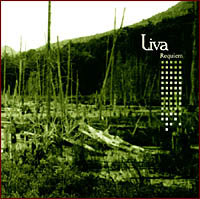
Label : Stoke Records
Sortie du Scud : novembre 2002
Pays : Canada
Genre : Metal / Musique classique
Type : Album
Playtime : 11 Titres - 58 Mins
Quand j'ai lu pour la première fois le tracklisting de Requiem, je me suis demandé si LIVA n'était pas le miracle que j'attendais tant, celui qui aurait eu l'idée d'écrire un album de Metal eucharistique. Car l'intitulé des morceaux ("Kyrie", "Sanctus", "Agnus Dei"...) ressemble à s'y méprendre aux thèmes qu'on retrouve habituellement sur une feuille de messe classique. J'ai bien tenté de vous faire gober que POWERWOLF s'y est récemment essayé (cf : chronique de Preachers Of The Night), mais rien de similaire aux attentes engendrées par le premier opus de nos cousins canadiens, paru en novembre 2002 sur Stoke Records. Et en réalité, l'idée de LIVA est encore plus géniale et cohérente, puisque guidée par "el maestro" Pier Carlo Liva, la formation a choisi pour concept le "Requiem Metal", un Metal orchestré tel un requiem, qui est certes une messe, mais surtout une célébration votive dédiée aux défunts.
L'univers artistique de LIVA est donc hautement singulier, peut-être addictif. Leur credo consiste en un mélange de musique classique et de Metal extrême, rien d'inédit vous allez dire puisque tout le monde ici connaît ADAGIO, HAGGARD ou THERION, trois groupes qui surfent sur cette vague depuis des lustres. Ainsi, la grosse différence réside ici dans l'appropriation. Les musiciens impliqués, Pier Carlo Live (composition, guitare, chant baryton et extrême), Catherine Elvira Chartier (chant soprano, alto et alto électrique) et Sébastien Breton (batterie), ont chacun suivi une initiation universitaire à la musique classique, ce qui, à vrai dire, déteint volontairement sur Requiem. Qu'il s'agisse de la virtuosité inhérente au classique ou de la technique propre au Metal, chaque élément est respecté, acheminé vers un équilibre qui se fait de plus en plus rare. LIVA a ce sens de l'harmonie quand d'autres ont le sens de l'outrance. "Kyrie" se suffit à lui-même en mise en bouche, mais c'est véritablement un "Dies Irae" plus sombre qui lance l'album. On connaissait la version de Verdi, inégalable. Celle-ci ne se défend pas mal avec ses connotations Mélodeath. Tout est fait dans la justesse, dans l'esprit d'une liturgie parfois rugueuse et enflammée aux ardeurs nuancées par le chant soprano de Catherine Elvira Chartier, qui œuvre même dans la restauration d'un opéra vétuste sur "Recordare". LIVA interprète son Metal néo-classique d'une façon si personnelle qu'on ne ressent en rien la présence des influences citées plus haut. Au contraire, l'évasion est de rigueur, comme un retour dans le passé amené entre autres par des paroles en latin et des arrangements moyenâgeux, dans le bon sens du terme pour une fois. Concept parfaitement élaboré et mené, on pourrait presque regretter que LIVA n'ait pas eu les moyens de s'entourer d'un orchestre professionnel pour exprimer ses idées avec davantage de grandiloquence. En effet, la production somme toute moyenne place l'ombre d'une barrière entre le groupe et l'auditeur, ce dernier captant sans mal les efforts du groupe mais sans jouir pour autant de la profondeur de son qu'il réclame.
Honnête et original, Requiem est surement l'album d'auteur le plus noble qui m'ait été donné d'écouter en matière de "Classic Metal". Pas le plus percutant ni même le plus inoubliable, mais assurément le plus complet. On le sait depuis longtemps, Heavy Metal et musique classique font bon ménage. D'ailleurs, si Wagner eut été un de nos contemporains, il se serait fort bien entendu avec LIVA, au point peut-être d'y chercher conseil.
Ajouté : Jeudi 16 Avril 2015 Chroniqueur : Stef. Score :     Lien en relation: Liva Website Hits: 8148
|