# Copyright (C) 2002-2004 gregoire HUBERT.
#
# This library is free software; you can redistribute it and/or
# modify it under the terms of the GNU Lesser General Public
# License as published by the Free Software Foundation; either
# version 2.1 of the License, or (at your option) any later version.
#
# This library is distributed in the hope that it will be useful,
# but WITHOUT ANY WARRANTY; without even the implied warranty of
# MERCHANTABILITY or FITNESS FOR A PARTICULAR PURPOSE. See the GNU
# Lesser General Public License for more details.
#
# You should have received a copy of the GNU Lesser General Public
# License along with this library; if not, write to the Free Software
# Foundation, Inc., 59 Temple Place, Suite 330, Boston, MA 02111-1307 USA
#
# Author : gregoire HUBERT
#
# XML_node.objet
#
# This object is an XML node representation
#
# /- name (string)
# xml_node --- attributes (array)
# \- children (array) or value (string)
class xml_node {
var $name;
var $attributes = array();
var $children = array();
var $value = "";
function xml_node($name,$attributes,$children=array(),$value="") {
$this->name = $name;
if (is_array($attributes)) {
$this->attributes = $attributes;
}
$this->children = $children;
$this->value = $value;
}
}
# Copyright (C) 2003-2004 gregoire HUBERT.
#
# This library is free software; you can redistribute it and/or
# modify it under the terms of the GNU Lesser General Public
# License as published by the Free Software Foundation; either
# version 2.1 of the License, or (at your option) any later version.
#
# This library is distributed in the hope that it will be useful,
# but WITHOUT ANY WARRANTY; without even the implied warranty of
# MERCHANTABILITY or FITNESS FOR A PARTICULAR PURPOSE. See the GNU
# Lesser General Public License for more details.
#
# You should have received a copy of the GNU Lesser General Public
# License along with this library; if not, write to the Free Software
# Foundation, Inc., 59 Temple Place, Suite 330, Boston, MA 02111-1307 USA
#
# Author : gregoire HUBERT
#
# xml_tree class
#
# This object parses an XML stream and offers a tree composed by xml_nodes
#
class xml_tree {
var $xml_stream;
var $current_node;
var $root_node;
var $index;
var $value;
function xml_tree() {
$this->root_node = new xml_node("__ROOT_NODE",array());
$this->current_node = $this->root_node;
}
function add_tree($xml_stream) {
# Managing the parser
$this->xml_stream = $xml_stream;
$xml_parser = xml_parser_create();
xml_parser_set_option($xml_parser,XML_OPTION_CASE_FOLDING,0);
xml_parser_set_option($xml_parser,XML_OPTION_SKIP_WHITE,1);
if (!xml_parse_into_struct($xml_parser,$this->xml_stream,$this->value,$this->index)) {
xml_parser_free($xml_parser);
die("XML Parse error");
}
xml_parser_free($xml_parser);
# Now, $this->value and $this->index are informed, we can use the get_node methode.
$tab_result = $this->get_node(0,count($this->value) - 1);
$this->root_node->children[] = $tab_result[0];
$this->current_node = $this->root_node;
}
function get_node($index_start,$index_stop) {
#echo " \n";
#echo "GET-NODE($index_start,$index_stop) \n";
# What we are going to return is an array of xml_nodes
$return_tab = array();
# depth is only here to check if everything is all right
$tab_node = $this->value[$index_start];
$depth = $tab_node["level"]-1;
# Now we have to be sure we do not forget a single node
for ($index = $index_start;$index <= $index_stop;$index++) {
#echo "\$index = $index ";
# get the current node
$tab_node = $this->value[$index];
# what type of node is it ?
switch($tab_node["type"]) {
case "complete" :
# Depth integrity check
if ($tab_node["level"] != $depth+1) {
die("ERREUR # contrainte d'intégrité au noeud complet $index, niveau $depth + 1 au lieu de ".$tab_node["level"]);
}
#echo "Noeud complet trouvé position $index TAG ".$tab_node["tag"]." \n";
# Easy one, no children to manage, only a value...
$return_tab[] = new xml_node($tab_node["tag"],$tab_node["attributes"],"",$tab_node["value"]);
break;
case "open" :
# Depth integrity check
if ($tab_node["level"] != $depth +1 ) {
die("ERREUR # contrainte d'intégrité au noeud ouvert $index, niveau $depth au lieu de ".$tab_node["level"]);
}
# Open tag, we re-use this methode to return its children
# Where is the correspondong close tag ?
$node_index = $this->index[$tab_node["tag"]];
$flipped_node_index = array_flip($node_index);
#echo "This ".$tab_node["tag"]." is at coords ".$flipped_node_index[$index]." ";
$i=1;
do {
$next_index = $node_index[$flipped_node_index[$index] + $i++];
$next_tag=$this->value[$next_index];
}
while ($next_tag["level"]!=$tab_node["level"]);
#echo "Ouverture de noeud détectée pos $index TAG ".$tab_node["tag"]." \n Parcours jusqu au $next_index \n";
# good, we can now instanciate our node
$return_tab[] = new xml_node($tab_node["tag"],$tab_node["attributes"],$this->get_node($index+1,$next_index),"");
# As we called the get_node methode, we are sure that nodes have been parsed to the corresponding close tag
$index = $next_index;
break;
case "close" :
# Depth integrity check
if ($tab_node["level"] != $depth ){
die("ERREUR # contrainte d'intégrité au noeud fermé $index, niveau $depth au lieu de ".$tab_node["level"]);
}
#echo "Fermeture de noeud detectée pos $index TAG ".$tab_node["tag"]."
\n";
# This ugly thing is useless because reaching a close tag means that $index==$index_stop but who knows ? =)
# it will be skipped soon
$index = $index_stop;
break;
default:
die("Erreur de type de TAG non déterminé :'".$tab_node["type"]."'");
}
}
# We are out ... returns the array with collected children...
return ($return_tab);
}
# this function browse the xml tree and set the current node to the selected node
function give_node($path) {
if ($path[0]=="/") {
$current_node=$this->root_node;
$path=substr($path,1);
#echo "ABSOLUTE PATH GIVEN=$path ";
}
else {
$current_node = $this->current_node;
}
#echo "PATH GIVEN=$path ";
$tab_path = split("/",$path);
foreach ($tab_path as $node_expr) {
#echo "STUDYING EXPR='$node_expr' ";
$node = $current_node;
$expr_tab = split("\?",$node_expr);
$node_name = $expr_tab[0];
$attr_tab = 0;
if (count($expr_tab)>1) {
##echo "TROUVE AU MOINS UNE CONDITION SUR LES ATTRIBUTS... ";
$attr_expr_tab=split(",",$expr_tab[1]);
$attr_tab=array();
foreach($attr_expr_tab as $attr_expr) {
$attr_split_expr=split("=",$attr_expr);
$attr_tab[$attr_split_expr[0]]=$attr_split_expr[1];
}
}
$last=0;
foreach ($node->children as $children) {
#echo "COMPARING WITH '$children->name' ";
if ($children->name == $node_name) {
##echo "TROUVE NOEUD CORRESPONDANT $node_name ";
if (is_array($attr_tab)) {
$node_attributes = $children->attributes;
foreach ($attr_tab as $key=>$value) {
if ($node_attributes[$key] == $value) {
#echo "ATTRIBUTE & CHANGE CURRENT NODE TO ".$children->name." ";
$current_node = $children;
$last = 1;
}
}
}
else {
##echo "CHILD=".$children->name." ";
#echo "CHANGE CURRENT NODE TO ".$children->name." ";
$current_node = $children;
$last=1;
}
}
if ($last) {
break;
}
}
if (!$last) {
#echo "PATH ERROR $node_name ";
#die("MMmmmh It seems that this file is not a DIA XML format...sorry...");
return 0;
}
}
return $current_node;
}
function browse_tree($path) {
$node = $this->give_node($path);
if (is_object($node)) {
$this->current_node = $node;
return 1;
}
return 0;
}
# this method dumps an html representation of the xml tree
function xml_show($node = "",$level=0,$last=0) {
if ($node=="") {
$node=$this->root_node;
}
if (!is_object($node)) {
die("ERROR : node is not an object");
}
$line="";
for($i=1;$i<=$level;$i++) {
if ((i==$level-1) and ($last)) {
$line.=" ";
}
else {
$line.=" |";
}
if ($i==$level) {
$line.="`-";
}
}
$line.=$node->name;
#echo $line;
$line.="".count($node->children)."";
if (count($node->children)==1) {
$line.=" (".$node->value.") \n";
echo "$line";
}
else {
$line.=" \n";
echo "$line";
$i=1;
foreach($node->children as $children) {
if ($i==count($node->children)) {
$this->xml_show($children,$level+1,1);
}
else {
$this->xml_show($children,$level+1);
}
$i++;
}
}
}
#END_CLASS
}
TYR (fo) - Eric The Red (2006)
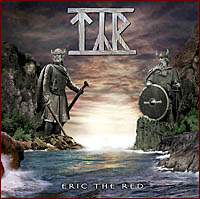
Label : Napalm Records / Season of Mist
Sortie du Scud : 24 Mars 2006
Pays : Iles Féroé
Genre : Viking Metal
Type : Album (réédition)
Playtime : 12 Titres - 70 Mins
Les Iles Féroé, vous savez où c’est ? C’est un petit archipel danois situé entre l’Islande, la Norvège et l’Ecosse. Et bien TYR est un groupe venant de cette partie du monde assez méconnu. Evoluant dans un registre mélangeant un Heavy Metal de tradition genre IRON MAIDEN, MANNOWAR et ANGRA, TYR a aussi un coté très folk scandinave et un coté très lyrique ce qui donne un Metal Viking qui fait penser aux albums Hammerheart ou Nordland I et II de BATHORY. Bien sûr, le nom du groupe n’est pas anodin car il s’agit du nom du dieu de la guerre dans la mythologie nordique.
Eric The Red, le second album du groupe, date en réalité du 27 juin 2003. Il était sorti à l’origine sur le label Tult Records. Maintenant, cet opus va bénéficier d’une distribution digne de ce nom avec cette signature chez Napalm Records. Cette réédition est agrémentée de deux titres bonus et d’une nouvelle pochette de toute beauté.
Chanté et en anglais et dans la langue locale, ce skeud surprend tout d’abord pas le timbre de voix si particulier de Heri Joensen, à la fois grave et puissant. Cet homme est également guitariste et principal compositeur du quatuor. Musicalement parlant, c’est assez difficile de coller une étiquette sans être trop réducteur tant la musique de TYR est variée et par moment majestueuse comme sur « Regin Smiour ». Le côté épique est omniprésent grâce aux chœurs monumentaux : « Dreams ». Les solos et harmonies de guitare ne sont pas en reste et viennent ajouter une dimension supplémentaire aux morceaux. Les titres sont inspirés et diversifiés grâce aux nombreux changements de rythme étonnants et originaux, parfois même pas trop appropriés. Ils sont le plus souvent mid-tempo, assez lourd avec un son de guitare grave. La durée globale est un peu excessive et certains titres peuvent devenir ennuyeux (« Rainbow Warrior » et « Ramund Hin Unge »). La production qui est très bonne, l’est même de trop : le son est propre et léché ce n’est pas adapté à ce genre de musique.
S’inspirant de vielles chansons scandinaves (dont « The Wild Rover », une reprise réussie !), Eric The Red est un bon album de Metal scandinave qui n’a pas à rougir (malgré ses principaux défauts qui sont la production clean et la durée de certains titres) par rapport aux offrandes de ses illustres voisins qui sont la Suède et la Norvège.
Ajouté : Mercredi 07 Juin 2006 Chroniqueur : Warloghe Score :    Lien en relation: Tyr Website Hits: 17799
|