# Copyright (C) 2002-2004 gregoire HUBERT.
#
# This library is free software; you can redistribute it and/or
# modify it under the terms of the GNU Lesser General Public
# License as published by the Free Software Foundation; either
# version 2.1 of the License, or (at your option) any later version.
#
# This library is distributed in the hope that it will be useful,
# but WITHOUT ANY WARRANTY; without even the implied warranty of
# MERCHANTABILITY or FITNESS FOR A PARTICULAR PURPOSE. See the GNU
# Lesser General Public License for more details.
#
# You should have received a copy of the GNU Lesser General Public
# License along with this library; if not, write to the Free Software
# Foundation, Inc., 59 Temple Place, Suite 330, Boston, MA 02111-1307 USA
#
# Author : gregoire HUBERT
#
# XML_node.objet
#
# This object is an XML node representation
#
# /- name (string)
# xml_node --- attributes (array)
# \- children (array) or value (string)
class xml_node {
var $name;
var $attributes = array();
var $children = array();
var $value = "";
function xml_node($name,$attributes,$children=array(),$value="") {
$this->name = $name;
if (is_array($attributes)) {
$this->attributes = $attributes;
}
$this->children = $children;
$this->value = $value;
}
}
# Copyright (C) 2003-2004 gregoire HUBERT.
#
# This library is free software; you can redistribute it and/or
# modify it under the terms of the GNU Lesser General Public
# License as published by the Free Software Foundation; either
# version 2.1 of the License, or (at your option) any later version.
#
# This library is distributed in the hope that it will be useful,
# but WITHOUT ANY WARRANTY; without even the implied warranty of
# MERCHANTABILITY or FITNESS FOR A PARTICULAR PURPOSE. See the GNU
# Lesser General Public License for more details.
#
# You should have received a copy of the GNU Lesser General Public
# License along with this library; if not, write to the Free Software
# Foundation, Inc., 59 Temple Place, Suite 330, Boston, MA 02111-1307 USA
#
# Author : gregoire HUBERT
#
# xml_tree class
#
# This object parses an XML stream and offers a tree composed by xml_nodes
#
class xml_tree {
var $xml_stream;
var $current_node;
var $root_node;
var $index;
var $value;
function xml_tree() {
$this->root_node = new xml_node("__ROOT_NODE",array());
$this->current_node = $this->root_node;
}
function add_tree($xml_stream) {
# Managing the parser
$this->xml_stream = $xml_stream;
$xml_parser = xml_parser_create();
xml_parser_set_option($xml_parser,XML_OPTION_CASE_FOLDING,0);
xml_parser_set_option($xml_parser,XML_OPTION_SKIP_WHITE,1);
if (!xml_parse_into_struct($xml_parser,$this->xml_stream,$this->value,$this->index)) {
xml_parser_free($xml_parser);
die("XML Parse error");
}
xml_parser_free($xml_parser);
# Now, $this->value and $this->index are informed, we can use the get_node methode.
$tab_result = $this->get_node(0,count($this->value) - 1);
$this->root_node->children[] = $tab_result[0];
$this->current_node = $this->root_node;
}
function get_node($index_start,$index_stop) {
#echo " \n";
#echo "GET-NODE($index_start,$index_stop) \n";
# What we are going to return is an array of xml_nodes
$return_tab = array();
# depth is only here to check if everything is all right
$tab_node = $this->value[$index_start];
$depth = $tab_node["level"]-1;
# Now we have to be sure we do not forget a single node
for ($index = $index_start;$index <= $index_stop;$index++) {
#echo "\$index = $index ";
# get the current node
$tab_node = $this->value[$index];
# what type of node is it ?
switch($tab_node["type"]) {
case "complete" :
# Depth integrity check
if ($tab_node["level"] != $depth+1) {
die("ERREUR # contrainte d'intégrité au noeud complet $index, niveau $depth + 1 au lieu de ".$tab_node["level"]);
}
#echo "Noeud complet trouvé position $index TAG ".$tab_node["tag"]." \n";
# Easy one, no children to manage, only a value...
$return_tab[] = new xml_node($tab_node["tag"],$tab_node["attributes"],"",$tab_node["value"]);
break;
case "open" :
# Depth integrity check
if ($tab_node["level"] != $depth +1 ) {
die("ERREUR # contrainte d'intégrité au noeud ouvert $index, niveau $depth au lieu de ".$tab_node["level"]);
}
# Open tag, we re-use this methode to return its children
# Where is the correspondong close tag ?
$node_index = $this->index[$tab_node["tag"]];
$flipped_node_index = array_flip($node_index);
#echo "This ".$tab_node["tag"]." is at coords ".$flipped_node_index[$index]." ";
$i=1;
do {
$next_index = $node_index[$flipped_node_index[$index] + $i++];
$next_tag=$this->value[$next_index];
}
while ($next_tag["level"]!=$tab_node["level"]);
#echo "Ouverture de noeud détectée pos $index TAG ".$tab_node["tag"]." \n Parcours jusqu au $next_index \n";
# good, we can now instanciate our node
$return_tab[] = new xml_node($tab_node["tag"],$tab_node["attributes"],$this->get_node($index+1,$next_index),"");
# As we called the get_node methode, we are sure that nodes have been parsed to the corresponding close tag
$index = $next_index;
break;
case "close" :
# Depth integrity check
if ($tab_node["level"] != $depth ){
die("ERREUR # contrainte d'intégrité au noeud fermé $index, niveau $depth au lieu de ".$tab_node["level"]);
}
#echo "Fermeture de noeud detectée pos $index TAG ".$tab_node["tag"]."
\n";
# This ugly thing is useless because reaching a close tag means that $index==$index_stop but who knows ? =)
# it will be skipped soon
$index = $index_stop;
break;
default:
die("Erreur de type de TAG non déterminé :'".$tab_node["type"]."'");
}
}
# We are out ... returns the array with collected children...
return ($return_tab);
}
# this function browse the xml tree and set the current node to the selected node
function give_node($path) {
if ($path[0]=="/") {
$current_node=$this->root_node;
$path=substr($path,1);
#echo "ABSOLUTE PATH GIVEN=$path ";
}
else {
$current_node = $this->current_node;
}
#echo "PATH GIVEN=$path ";
$tab_path = split("/",$path);
foreach ($tab_path as $node_expr) {
#echo "STUDYING EXPR='$node_expr' ";
$node = $current_node;
$expr_tab = split("\?",$node_expr);
$node_name = $expr_tab[0];
$attr_tab = 0;
if (count($expr_tab)>1) {
##echo "TROUVE AU MOINS UNE CONDITION SUR LES ATTRIBUTS... ";
$attr_expr_tab=split(",",$expr_tab[1]);
$attr_tab=array();
foreach($attr_expr_tab as $attr_expr) {
$attr_split_expr=split("=",$attr_expr);
$attr_tab[$attr_split_expr[0]]=$attr_split_expr[1];
}
}
$last=0;
foreach ($node->children as $children) {
#echo "COMPARING WITH '$children->name' ";
if ($children->name == $node_name) {
##echo "TROUVE NOEUD CORRESPONDANT $node_name ";
if (is_array($attr_tab)) {
$node_attributes = $children->attributes;
foreach ($attr_tab as $key=>$value) {
if ($node_attributes[$key] == $value) {
#echo "ATTRIBUTE & CHANGE CURRENT NODE TO ".$children->name." ";
$current_node = $children;
$last = 1;
}
}
}
else {
##echo "CHILD=".$children->name." ";
#echo "CHANGE CURRENT NODE TO ".$children->name." ";
$current_node = $children;
$last=1;
}
}
if ($last) {
break;
}
}
if (!$last) {
#echo "PATH ERROR $node_name ";
#die("MMmmmh It seems that this file is not a DIA XML format...sorry...");
return 0;
}
}
return $current_node;
}
function browse_tree($path) {
$node = $this->give_node($path);
if (is_object($node)) {
$this->current_node = $node;
return 1;
}
return 0;
}
# this method dumps an html representation of the xml tree
function xml_show($node = "",$level=0,$last=0) {
if ($node=="") {
$node=$this->root_node;
}
if (!is_object($node)) {
die("ERROR : node is not an object");
}
$line="";
for($i=1;$i<=$level;$i++) {
if ((i==$level-1) and ($last)) {
$line.=" ";
}
else {
$line.=" |";
}
if ($i==$level) {
$line.="`-";
}
}
$line.=$node->name;
#echo $line;
$line.="".count($node->children)."";
if (count($node->children)==1) {
$line.=" (".$node->value.") \n";
echo "$line";
}
else {
$line.=" \n";
echo "$line";
$i=1;
foreach($node->children as $children) {
if ($i==count($node->children)) {
$this->xml_show($children,$level+1,1);
}
else {
$this->xml_show($children,$level+1);
}
$i++;
}
}
}
#END_CLASS
}
LACERATION (uk) - Severing The Divine Iniquity (2013)
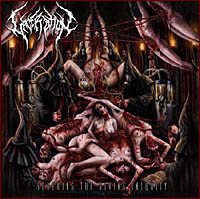
Label : New Standard Elite
Sortie du Scud : février 2012
Pays : Ecosse
Genre : Brutal Death Metal
Type : Album
Playtime : 9 Titres - 28 Mins
Hamish Maguire est un garçon tout à fait fascinant. D’abord, il ferait un bon cobaye pour un anthropologue qui chercherait à comprendre pourquoi le Britannique a souvent ce faciès de bœuf musqué là où le reste du monde a généralement un simple visage. Ensuite, il est la preuve vivante que le Death Metal n’attend pas le nombre des années. A seulement 19 ans, il déculotte les grandes pointures du Brutal Death sans aide extérieure, avec pour seule arme la volonté de broyer. Et je suis sincèrement convaincu qu’à côté de sa musique, l’attentat de Valentin Eysseric qui a littéralement explosé la cheville du stéphanois Jérémy Clément, au point d’en faire sortir l’os du tibia, est un acte d’une infinie poésie. Je ne vais pas vous cacher les faits plus longtemps, LACERATION est un de mes petits chouchous. Découvert par le plus grand des hasards sur la compilation studio-live Tortured Inauguration de 2012 (lire par ailleurs), ce one-man band m’a littéralement scotché. Je me demande encore comment cet infâme pourceau a pu vampiriser à lui seul le talent d’un groupe de renom comme CANNIBAL CORPSE, mais passons.
L’essentiel est désormais d’évoquer Severing The Divine Iniquity, un vrai premier album fait avec les moyens du bord qui récompense déjà quatre années de travaux (le mec avait donc 16 piges à l’époque, à part ça tout va bien). Je vais peut-être faire bref et commencer par les points négatifs, tant ils sont peu nombreux. Hamish, mon petit Hamish, tu dois absolument te dégoter un batteur. Parce qu’avec une telle qualité dans l’écriture, une telle justesse dans l’exécution, une production aussi organique, c’est une faute professionnelle que de déshumaniser ta musique en usant (et abusant) d’une boite à rythmes. Crois-moi, ton Death Metal plus que passable tutoiera alors l’excellence et c’est tout ce que tu mérites. Car en ce qui concerne l’effervescence et la folie qui dégoulinent de ton premier album, tu as tout bon. Ce Brutal Death est dégueulasse, visqueux, faisandé et nécrosé. Il y avait déjà le son mais maintenant, il y a aussi l’image. C’est la première fois que le concept est matérialisé de manière aussi précise, tant musicalement que visuellement. Et l’harmonie entre les deux offre des compositions précises, techniques, évoluées. Du AVULSED dans la forme, du REGURGITATE dans le fond. On pourrait également évoquer tous ces groupes sud-américains passionnés de clitoridotomie et de scalpels plantés dans l’anus d’un fœtus, mais ça serait faire trop d’honneur à une imagerie pour le coup jusqu’au-boutiste. Non, le plus choquant dans l’histoire reste la dextérité avec laquelle tu enchaines ces riffs massifs, ces breaks déstructurés et la vitesse avec laquelle tu redémarres au titre suivant. Dans le lot, il n’y a que « Flesh Sculpted Atrocity » qui dégonfle un peu, et encore, tu auras mis une minute avant de prendre cette décision. On pourra dire de toi que tu fonces tête-bêche dans le tas, peut-être dans le mur. Mais si c’est un mur, tu l’éventreras jusqu’à la dernière brique, parce que tu as de l’or dans les doigts, un grand cœur et un cerveau en état de marche. J’ai passé avec ce premier album un excellent moment, d’une sévérité inouïe mais on n’est tous un peu masos quand on s’enfile volontairement pareil châtiment auditif.
Le plus dur reste à venir, tu vas devoir faire tes preuves et Dieu sait que tu ne tiendras pas le choc en restant seul, alors entoure toi d’au moins une personne de confiance qui saura t’aiguiller et gommer tes erreurs de jeunesse. Je ne sais pas si tu comprendras ces mots ni même si tu les liras, mais si c’est le cas, saches qu’en France, ton blaze est désormais référencé et qu’au nom d’un grand nombre de notre lectorat, tu as un soutien. Je prends le pari qu’il ne peut pas en être autrement.
Ajouté : Mercredi 06 Mars 2013 Chroniqueur : Stef. Score :     Lien en relation: Laceration Website Hits: 9648
|