# Copyright (C) 2002-2004 gregoire HUBERT.
#
# This library is free software; you can redistribute it and/or
# modify it under the terms of the GNU Lesser General Public
# License as published by the Free Software Foundation; either
# version 2.1 of the License, or (at your option) any later version.
#
# This library is distributed in the hope that it will be useful,
# but WITHOUT ANY WARRANTY; without even the implied warranty of
# MERCHANTABILITY or FITNESS FOR A PARTICULAR PURPOSE. See the GNU
# Lesser General Public License for more details.
#
# You should have received a copy of the GNU Lesser General Public
# License along with this library; if not, write to the Free Software
# Foundation, Inc., 59 Temple Place, Suite 330, Boston, MA 02111-1307 USA
#
# Author : gregoire HUBERT
#
# XML_node.objet
#
# This object is an XML node representation
#
# /- name (string)
# xml_node --- attributes (array)
# \- children (array) or value (string)
class xml_node {
var $name;
var $attributes = array();
var $children = array();
var $value = "";
function xml_node($name,$attributes,$children=array(),$value="") {
$this->name = $name;
if (is_array($attributes)) {
$this->attributes = $attributes;
}
$this->children = $children;
$this->value = $value;
}
}
# Copyright (C) 2003-2004 gregoire HUBERT.
#
# This library is free software; you can redistribute it and/or
# modify it under the terms of the GNU Lesser General Public
# License as published by the Free Software Foundation; either
# version 2.1 of the License, or (at your option) any later version.
#
# This library is distributed in the hope that it will be useful,
# but WITHOUT ANY WARRANTY; without even the implied warranty of
# MERCHANTABILITY or FITNESS FOR A PARTICULAR PURPOSE. See the GNU
# Lesser General Public License for more details.
#
# You should have received a copy of the GNU Lesser General Public
# License along with this library; if not, write to the Free Software
# Foundation, Inc., 59 Temple Place, Suite 330, Boston, MA 02111-1307 USA
#
# Author : gregoire HUBERT
#
# xml_tree class
#
# This object parses an XML stream and offers a tree composed by xml_nodes
#
class xml_tree {
var $xml_stream;
var $current_node;
var $root_node;
var $index;
var $value;
function xml_tree() {
$this->root_node = new xml_node("__ROOT_NODE",array());
$this->current_node = $this->root_node;
}
function add_tree($xml_stream) {
# Managing the parser
$this->xml_stream = $xml_stream;
$xml_parser = xml_parser_create();
xml_parser_set_option($xml_parser,XML_OPTION_CASE_FOLDING,0);
xml_parser_set_option($xml_parser,XML_OPTION_SKIP_WHITE,1);
if (!xml_parse_into_struct($xml_parser,$this->xml_stream,$this->value,$this->index)) {
xml_parser_free($xml_parser);
die("XML Parse error");
}
xml_parser_free($xml_parser);
# Now, $this->value and $this->index are informed, we can use the get_node methode.
$tab_result = $this->get_node(0,count($this->value) - 1);
$this->root_node->children[] = $tab_result[0];
$this->current_node = $this->root_node;
}
function get_node($index_start,$index_stop) {
#echo " \n";
#echo "GET-NODE($index_start,$index_stop) \n";
# What we are going to return is an array of xml_nodes
$return_tab = array();
# depth is only here to check if everything is all right
$tab_node = $this->value[$index_start];
$depth = $tab_node["level"]-1;
# Now we have to be sure we do not forget a single node
for ($index = $index_start;$index <= $index_stop;$index++) {
#echo "\$index = $index ";
# get the current node
$tab_node = $this->value[$index];
# what type of node is it ?
switch($tab_node["type"]) {
case "complete" :
# Depth integrity check
if ($tab_node["level"] != $depth+1) {
die("ERREUR # contrainte d'intégrité au noeud complet $index, niveau $depth + 1 au lieu de ".$tab_node["level"]);
}
#echo "Noeud complet trouvé position $index TAG ".$tab_node["tag"]." \n";
# Easy one, no children to manage, only a value...
$return_tab[] = new xml_node($tab_node["tag"],$tab_node["attributes"],"",$tab_node["value"]);
break;
case "open" :
# Depth integrity check
if ($tab_node["level"] != $depth +1 ) {
die("ERREUR # contrainte d'intégrité au noeud ouvert $index, niveau $depth au lieu de ".$tab_node["level"]);
}
# Open tag, we re-use this methode to return its children
# Where is the correspondong close tag ?
$node_index = $this->index[$tab_node["tag"]];
$flipped_node_index = array_flip($node_index);
#echo "This ".$tab_node["tag"]." is at coords ".$flipped_node_index[$index]." ";
$i=1;
do {
$next_index = $node_index[$flipped_node_index[$index] + $i++];
$next_tag=$this->value[$next_index];
}
while ($next_tag["level"]!=$tab_node["level"]);
#echo "Ouverture de noeud détectée pos $index TAG ".$tab_node["tag"]." \n Parcours jusqu au $next_index \n";
# good, we can now instanciate our node
$return_tab[] = new xml_node($tab_node["tag"],$tab_node["attributes"],$this->get_node($index+1,$next_index),"");
# As we called the get_node methode, we are sure that nodes have been parsed to the corresponding close tag
$index = $next_index;
break;
case "close" :
# Depth integrity check
if ($tab_node["level"] != $depth ){
die("ERREUR # contrainte d'intégrité au noeud fermé $index, niveau $depth au lieu de ".$tab_node["level"]);
}
#echo "Fermeture de noeud detectée pos $index TAG ".$tab_node["tag"]."
\n";
# This ugly thing is useless because reaching a close tag means that $index==$index_stop but who knows ? =)
# it will be skipped soon
$index = $index_stop;
break;
default:
die("Erreur de type de TAG non déterminé :'".$tab_node["type"]."'");
}
}
# We are out ... returns the array with collected children...
return ($return_tab);
}
# this function browse the xml tree and set the current node to the selected node
function give_node($path) {
if ($path[0]=="/") {
$current_node=$this->root_node;
$path=substr($path,1);
#echo "ABSOLUTE PATH GIVEN=$path ";
}
else {
$current_node = $this->current_node;
}
#echo "PATH GIVEN=$path ";
$tab_path = split("/",$path);
foreach ($tab_path as $node_expr) {
#echo "STUDYING EXPR='$node_expr' ";
$node = $current_node;
$expr_tab = split("\?",$node_expr);
$node_name = $expr_tab[0];
$attr_tab = 0;
if (count($expr_tab)>1) {
##echo "TROUVE AU MOINS UNE CONDITION SUR LES ATTRIBUTS... ";
$attr_expr_tab=split(",",$expr_tab[1]);
$attr_tab=array();
foreach($attr_expr_tab as $attr_expr) {
$attr_split_expr=split("=",$attr_expr);
$attr_tab[$attr_split_expr[0]]=$attr_split_expr[1];
}
}
$last=0;
foreach ($node->children as $children) {
#echo "COMPARING WITH '$children->name' ";
if ($children->name == $node_name) {
##echo "TROUVE NOEUD CORRESPONDANT $node_name ";
if (is_array($attr_tab)) {
$node_attributes = $children->attributes;
foreach ($attr_tab as $key=>$value) {
if ($node_attributes[$key] == $value) {
#echo "ATTRIBUTE & CHANGE CURRENT NODE TO ".$children->name." ";
$current_node = $children;
$last = 1;
}
}
}
else {
##echo "CHILD=".$children->name." ";
#echo "CHANGE CURRENT NODE TO ".$children->name." ";
$current_node = $children;
$last=1;
}
}
if ($last) {
break;
}
}
if (!$last) {
#echo "PATH ERROR $node_name ";
#die("MMmmmh It seems that this file is not a DIA XML format...sorry...");
return 0;
}
}
return $current_node;
}
function browse_tree($path) {
$node = $this->give_node($path);
if (is_object($node)) {
$this->current_node = $node;
return 1;
}
return 0;
}
# this method dumps an html representation of the xml tree
function xml_show($node = "",$level=0,$last=0) {
if ($node=="") {
$node=$this->root_node;
}
if (!is_object($node)) {
die("ERROR : node is not an object");
}
$line="";
for($i=1;$i<=$level;$i++) {
if ((i==$level-1) and ($last)) {
$line.=" ";
}
else {
$line.=" |";
}
if ($i==$level) {
$line.="`-";
}
}
$line.=$node->name;
#echo $line;
$line.="".count($node->children)."";
if (count($node->children)==1) {
$line.=" (".$node->value.") \n";
echo "$line";
}
else {
$line.=" \n";
echo "$line";
$i=1;
foreach($node->children as $children) {
if ($i==count($node->children)) {
$this->xml_show($children,$level+1,1);
}
else {
$this->xml_show($children,$level+1);
}
$i++;
}
}
}
#END_CLASS
}
LACERATION (uk) – Tortured Inauguration (2012)
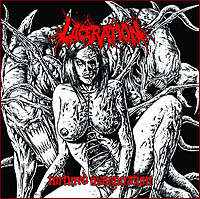
Label : UKEM Records
Sortie du Scud : février 2012
Pays : Ecosse
Genre : Brutal Death Metal
Type : Album
Playtime : 8 Titres - 24 Mins
Avant de commencer, il serait de bon ton de mettre un contexte dans cette review. J’écris ces quelques lignes à une semaine de la St-Valentin. Les cœurs fleurissent actuellement un peu partout et un parfum de poésie parcourt une ambiance extérieure sibérienne. Idéalement, le Tortured Inauguration de LACERATION n’est pas le plus romantique des cadeaux à faire à sa dulcinée. Et pour cause, diffuser un « Gorging On Putrid Orifices » en ce soir béni des éconduits serait un acte d’une belle indélicatesse. La moelle de ce projet écossais s’appelle Hamish Maguire et n’a, a fortiori, aucun lien de parenté avec l’homme-araignée (comprenne qui pourra). Et aussi improbable que ça puisse paraître, ce tout jeune britannique a qui je donne à peine la majorité, est seul maître à bord d’un vaisseau fantôme qui compte beaucoup d’admirateurs outre-manche. La sortie récente de ce premier album (plutôt une compilation en réalité) l’aidera, j’en suis sûr, à asseoir encore un peu plus sa crédibilité.
Parce qu’il faut bien être clair. Si ce joli pourceau a choisi le Brutal Death à l’ancienne comme style de prédilection, il est évident que c’est tout sauf un hasard. Visiblement, ce gamin en a bien bouffé dans sa jeunesse, au point d’en avoir accumulé quelques kilos superflus. Cet album, je vous le disais, est donc l’intégrale de ses travaux. Les trois premiers titres sont issus de son CD Promo de 2011, deux autres de son premier EP paru en 2010 et les trois derniers, d’un live enregistré au Death Metal Tea Party de Glasgow en janvier 2012. Stylistiquement, aucune différence entre ces trois périodes. Le tout est même sacrément homogène et étouffant. On se rappellera bien entendu des commencements de GORGASM ou de DEVOURMENT, surtout dans cette approche très basique et scolaire d’un riffing bourdonnant. Les tempos n’ont rien d’extraordinaire. Je pensais ça, jusqu’à l’arrivée de « Human Tikka Massala » et de son intro écrasante en down-tempo qui donnerait des complexes au dernier extrait du nouveau CANNIBAL CORPSE, « Scourge Of Iron ». Ces trois premières propositions sont d’excellente facture et surprenantes d’authenticité. La donne change légèrement à partir de « Force Fed Fecal Matter » mais rien de bien choquant, tout simplement parce que cette compo n’a pas la même origine que les précédentes. La production est un peu plus rustre, renfermée et le chant d’Hamish ressemble plus à une chasse d’eau qu’à de convaincants gargarismes. L’utilisation d’une boîte à rythme, bien que justifiée quand on choisit d’être un one-man band, n’aide pas vraiment à l’épanouissement de ce Death violent qui mériterait davantage de moyens humains pour vraiment exploser. Néanmoins, LACERATION fait preuve d’une grande application sur cet opus qui, à la fois sous ses coutures les plus catchys et derrière ses faux-airs de porcherie mal organisée, mettra quelques personnes sur le cul. Petit bémol concernant la présence de trois morceaux recordés en live, dont la qualité sonore dégueulasse nous coupe l’envie d’aller emmancher quelques truies. L’intérêt purement artistique de ce choix contestable est inexistant.
Ce qui est chouette, en revanche, c’est que le plaisir non-feint d’avoir passé ces quelques minutes avec Hamish ne s’est pas volatilisé. Je tire mon chapeau à ce garçon pour la qualité manifeste de son travail, qui dans l’émotion, dans la sincérité, dans l’exécution, dans la forme autant que dans le fond, mérite une attention toute particulière. La seule recommandation qu’on puisse lui adresser, c’est de s’entourer très vite de musiciens aguerris, car ce projet pourrait bien faire très mal à l’avenir !
Ajouté : Mercredi 22 Février 2012 Chroniqueur : Stef. Score :     Lien en relation: Laceration Website Hits: 10028
|