#
# XML_node.objet
#
# This object is an XML node representation
#
# /- name (string)
# xml_node --- attributes (array)
# \- children (array) or value (string)
class xml_node {
var $name;
var $attributes = array();
var $children = array();
var $value = "";
function xml_node($name,$attributes,$children=array(),$value="") {
$this->name = $name;
if (is_array($attributes)) {
$this->attributes = $attributes;
}
$this->children = $children;
$this->value = $value;
}
}
#
# xml_tree class
#
# This object parses an XML stream and offers a tree composed by xml_nodes
#
class xml_tree {
var $xml_stream;
var $current_node;
var $root_node;
var $index;
var $value;
function xml_tree() {
$this->root_node = new xml_node("__ROOT_NODE",array());
$this->current_node = $this->root_node;
}
function add_tree($xml_stream) {
# Managing the parser
$this->xml_stream = $xml_stream;
$xml_parser = xml_parser_create();
xml_parser_set_option($xml_parser,XML_OPTION_CASE_FOLDING,0);
xml_parser_set_option($xml_parser,XML_OPTION_SKIP_WHITE,1);
if (!xml_parse_into_struct($xml_parser,$this->xml_stream,$this->value,$this->index)) {
xml_parser_free($xml_parser);
die("XML Parse error");
}
xml_parser_free($xml_parser);
# Now, $this->value and $this->index are informed, we can use the get_node methode.
$tab_result = $this->get_node(0,count($this->value) - 1);
$this->root_node->children[] = $tab_result[0];
$this->current_node = $this->root_node;
}
function get_node($index_start,$index_stop) {
#echo "
\n";
#echo "GET-NODE($index_start,$index_stop)
\n";
# What we are going to return is an array of xml_nodes
$return_tab = array();
# depth is only here to check if everything is all right
$tab_node = $this->value[$index_start];
$depth = $tab_node["level"]-1;
# Now we have to be sure we do not forget a single node
for ($index = $index_start;$index <= $index_stop;$index++) {
#echo "\$index = $index
";
# get the current node
$tab_node = $this->value[$index];
# what type of node is it ?
switch($tab_node["type"]) {
case "complete" :
# Depth integrity check
if ($tab_node["level"] != $depth+1) {
die("ERREUR # contrainte d'intégrité au noeud complet $index, niveau $depth + 1 au lieu de ".$tab_node["level"]);
}
#echo "Noeud complet trouvé position $index TAG ".$tab_node["tag"]."
\n";
# Easy one, no children to manage, only a value...
$return_tab[] = new xml_node($tab_node["tag"],$tab_node["attributes"],"",$tab_node["value"]);
break;
case "open" :
# Depth integrity check
if ($tab_node["level"] != $depth +1 ) {
die("ERREUR # contrainte d'intégrité au noeud ouvert $index, niveau $depth au lieu de ".$tab_node["level"]);
}
# Open tag, we re-use this methode to return its children
# Where is the correspondong close tag ?
$node_index = $this->index[$tab_node["tag"]];
$flipped_node_index = array_flip($node_index);
#echo "This ".$tab_node["tag"]." is at coords ".$flipped_node_index[$index]."
";
$i=1;
do {
$next_index = $node_index[$flipped_node_index[$index] + $i++];
$next_tag=$this->value[$next_index];
}
while ($next_tag["level"]!=$tab_node["level"]);
#echo "Ouverture de noeud détectée pos $index TAG ".$tab_node["tag"]."
\n Parcours jusqu au $next_index
\n";
# good, we can now instanciate our node
$return_tab[] = new xml_node($tab_node["tag"],$tab_node["attributes"],$this->get_node($index+1,$next_index),"");
# As we called the get_node methode, we are sure that nodes have been parsed to the corresponding close tag
$index = $next_index;
break;
case "close" :
# Depth integrity check
if ($tab_node["level"] != $depth ){
die("ERREUR # contrainte d'intégrité au noeud fermé $index, niveau $depth au lieu de ".$tab_node["level"]);
}
#echo "Fermeture de noeud detectée pos $index TAG ".$tab_node["tag"]."
\n";
# This ugly thing is useless because reaching a close tag means that $index==$index_stop but who knows ? =)
# it will be skipped soon
$index = $index_stop;
break;
default:
die("Erreur de type de TAG non déterminé :'".$tab_node["type"]."'");
}
}
# We are out ... returns the array with collected children...
return ($return_tab);
}
# this function browse the xml tree and set the current node to the selected node
function give_node($path) {
if ($path[0]=="/") {
$current_node=$this->root_node;
$path=substr($path,1);
#echo "ABSOLUTE PATH GIVEN=$path
";
}
else {
$current_node = $this->current_node;
}
#echo "PATH GIVEN=$path
";
$tab_path = split("/",$path);
foreach ($tab_path as $node_expr) {
#echo "STUDYING EXPR='$node_expr'
";
$node = $current_node;
$expr_tab = split("\?",$node_expr);
$node_name = $expr_tab[0];
$attr_tab = 0;
if (count($expr_tab)>1) {
##echo "TROUVE AU MOINS UNE CONDITION SUR LES ATTRIBUTS...
";
$attr_expr_tab=split(",",$expr_tab[1]);
$attr_tab=array();
foreach($attr_expr_tab as $attr_expr) {
$attr_split_expr=split("=",$attr_expr);
$attr_tab[$attr_split_expr[0]]=$attr_split_expr[1];
}
}
$last=0;
foreach ($node->children as $children) {
#echo "COMPARING WITH '$children->name'
";
if ($children->name == $node_name) {
##echo "TROUVE NOEUD CORRESPONDANT $node_name
";
if (is_array($attr_tab)) {
$node_attributes = $children->attributes;
foreach ($attr_tab as $key=>$value) {
if ($node_attributes[$key] == $value) {
#echo "ATTRIBUTE & CHANGE CURRENT NODE TO ".$children->name."
";
$current_node = $children;
$last = 1;
}
}
}
else {
##echo "CHILD=".$children->name."
";
#echo "CHANGE CURRENT NODE TO ".$children->name."
";
$current_node = $children;
$last=1;
}
}
if ($last) {
break;
}
}
if (!$last) {
#echo "PATH ERROR $node_name
";
#die("MMmmmh It seems that this file is not a DIA XML format...sorry...");
return 0;
}
}
return $current_node;
}
function browse_tree($path) {
$node = $this->give_node($path);
if (is_object($node)) {
$this->current_node = $node;
return 1;
}
return 0;
}
# this method dumps an html representation of the xml tree
function xml_show($node = "",$level=0,$last=0) {
if ($node=="") {
$node=$this->root_node;
}
if (!is_object($node)) {
die("ERROR : node is not an object");
}
$line="";
for($i=1;$i<=$level;$i++) {
if ((i==$level-1) and ($last)) {
$line.=" ";
}
else {
$line.=" |";
}
if ($i==$level) {
$line.="`-";
}
}
$line.=$node->name;
#echo $line;
$line.="".count($node->children)."";
if (count($node->children)==1) {
$line.=" (".$node->value.")
\n";
echo "$line";
}
else {
$line.="
\n";
echo "$line";
$i=1;
foreach($node->children as $children) {
if ($i==count($node->children)) {
$this->xml_show($children,$level+1,1);
}
else {
$this->xml_show($children,$level+1);
}
$i++;
}
}
}
#END_CLASS
}
PERSEFONE (ad) - Shin-Ken (2010)
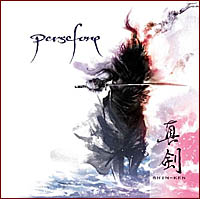
Label : Kolony Records
Sortie du Scud : février 2010
Pays : Andorre
Genre : Samouraï Metal
Type : Album
Playtime : 14 Titres - 67 Mins
Un groupe venu d’Andorre, c’est déjà pas banal. Mais un groupe venu d’Andorre qui livre une ode passionnée aux arts ancestraux de la guerre japonais au travers d’un Death symphonique, ça relève presque de la polygamie interraciale. PERSEFONE est son nom. Nullement influencé par la tendance générale de produire des démos à la pelle, le combo plonge dans le bain avec un premier album (Truth Inside The Shades) en 2004 suivi d’un deuxième (Core) en 2006, tous deux très encensés par la critique, sans doute peu habituée à recevoir dans ses locaux luxuriant des musiciens qui sont encore sous le commandement d’un prince. Jouant sur ce petit détail, le sextet propose avec Shin-Ken son premier concept-album autour du thème de la culture et des rites au pays du soleil levant. La cover très pure et à laquelle il ne manque qu’un sushi pour être plus kitsch nous montre le yamato sur lequel on est sur le point d’embarquer.
L’idée de concept-album réfère souvent à une mise en scène particulière. Sans surprises, « The Ground Book » est une relaxante introduction où ruissellements apaisants et claviers zens viennent se croiser. La thérapie est rompue par « Fall To Rise » qui effectue une cavalcade épique armé de ses riffs les plus tranchants. Cette composition est déjà très conceptuelle… on y retrouve un break rythmique intelligent composé de notes d’un instrument traditionnel nippon (probablement le Koto mais je ne mettrais pas ma main à couper…) et d’un refrain atmosphérique avec un chant de tête liquoreux. PERSEFONE offre déjà une diversité agréable qui ira crescendo. L’utilisation des claviers par Miguel est idyllique et nous emporte vraiment dans un voyage à l’autre bout du monde. A ce titre, « Purity » rompt parfaitement avec les codes établis au début de l’album. En décalage complet, cette composition plus Pop dotée d’un très beau solo de guitare met en valeur le travail de création des musiciens. Shin-Ken qui a bénéficié d’un mixage aux studios de Tommy Hansen dévoile un compromis rarement exploité entre ambiances japonisantes et dureté d’un Metal brut. Et on sent bien que le filon n’a pas encore exactement écrit ses lettres de noblesse, puisque PERSEFONE se perd souvent dans des guitares beaucoup trop percutantes et dont découle un manque de finesse. Même commentaire au niveau du chant, parfois trop caverneux et bestial alors que l’instant appelle à davantage de poésie et de verbe. Il est donc fort bienvenu que les andorrans rattrapent cette carence en doigté avec les innombrables frasques sur l’univers traditionnel japonais. Entre « The Fire Book » et « Japanese Poem », les titres contenants des appels à l’évasion et au rêve ne manquent pas et rivalisent d’imagination. Ces orchestrations nous permettent de nous concentrer sur autre chose que la qualité intrinsèque des zicos, qui font tout de même parler la poudre à quelques reprises comme sur l’excellente « The Endless Path ».
En définitive, Shin-Ken nous paye un voyage totalement dépaysant au sein d’une culture bien particulière. PERSEFONE a réussi son pari et à retranscrit à la perfection l’atmosphère des traditions guerrières nippones grâce à l’usage de nombreux instruments typiques, ces derniers étant suffisamment mis en avant pour canaliser (dissimuler ?) leur surplus d’excitation. L’équilibre n’est pas encore trouvé mais ça ne saurait tarder. PERSEFONE est donc un groupe qu’on peut facilement Saké !
Ajouté : Mardi 20 Juillet 2010
Chroniqueur : Stef.
Score :  
Lien en relation: Persefone Website
Hits: 13906
|


 | © Metal-Impact Since 2001 | Webmaster et Rédacteur en chef : Blasphy De Blasphèmar
 Rechercher sur M-I