# Copyright (C) 2002-2004 gregoire HUBERT.
#
# This library is free software; you can redistribute it and/or
# modify it under the terms of the GNU Lesser General Public
# License as published by the Free Software Foundation; either
# version 2.1 of the License, or (at your option) any later version.
#
# This library is distributed in the hope that it will be useful,
# but WITHOUT ANY WARRANTY; without even the implied warranty of
# MERCHANTABILITY or FITNESS FOR A PARTICULAR PURPOSE. See the GNU
# Lesser General Public License for more details.
#
# You should have received a copy of the GNU Lesser General Public
# License along with this library; if not, write to the Free Software
# Foundation, Inc., 59 Temple Place, Suite 330, Boston, MA 02111-1307 USA
#
# Author : gregoire HUBERT
#
# XML_node.objet
#
# This object is an XML node representation
#
# /- name (string)
# xml_node --- attributes (array)
# \- children (array) or value (string)
class xml_node {
var $name;
var $attributes = array();
var $children = array();
var $value = "";
function xml_node($name,$attributes,$children=array(),$value="") {
$this->name = $name;
if (is_array($attributes)) {
$this->attributes = $attributes;
}
$this->children = $children;
$this->value = $value;
}
}
# Copyright (C) 2003-2004 gregoire HUBERT.
#
# This library is free software; you can redistribute it and/or
# modify it under the terms of the GNU Lesser General Public
# License as published by the Free Software Foundation; either
# version 2.1 of the License, or (at your option) any later version.
#
# This library is distributed in the hope that it will be useful,
# but WITHOUT ANY WARRANTY; without even the implied warranty of
# MERCHANTABILITY or FITNESS FOR A PARTICULAR PURPOSE. See the GNU
# Lesser General Public License for more details.
#
# You should have received a copy of the GNU Lesser General Public
# License along with this library; if not, write to the Free Software
# Foundation, Inc., 59 Temple Place, Suite 330, Boston, MA 02111-1307 USA
#
# Author : gregoire HUBERT
#
# xml_tree class
#
# This object parses an XML stream and offers a tree composed by xml_nodes
#
class xml_tree {
var $xml_stream;
var $current_node;
var $root_node;
var $index;
var $value;
function xml_tree() {
$this->root_node = new xml_node("__ROOT_NODE",array());
$this->current_node = $this->root_node;
}
function add_tree($xml_stream) {
# Managing the parser
$this->xml_stream = $xml_stream;
$xml_parser = xml_parser_create();
xml_parser_set_option($xml_parser,XML_OPTION_CASE_FOLDING,0);
xml_parser_set_option($xml_parser,XML_OPTION_SKIP_WHITE,1);
if (!xml_parse_into_struct($xml_parser,$this->xml_stream,$this->value,$this->index)) {
xml_parser_free($xml_parser);
die("XML Parse error");
}
xml_parser_free($xml_parser);
# Now, $this->value and $this->index are informed, we can use the get_node methode.
$tab_result = $this->get_node(0,count($this->value) - 1);
$this->root_node->children[] = $tab_result[0];
$this->current_node = $this->root_node;
}
function get_node($index_start,$index_stop) {
#echo " \n";
#echo "GET-NODE($index_start,$index_stop) \n";
# What we are going to return is an array of xml_nodes
$return_tab = array();
# depth is only here to check if everything is all right
$tab_node = $this->value[$index_start];
$depth = $tab_node["level"]-1;
# Now we have to be sure we do not forget a single node
for ($index = $index_start;$index <= $index_stop;$index++) {
#echo "\$index = $index ";
# get the current node
$tab_node = $this->value[$index];
# what type of node is it ?
switch($tab_node["type"]) {
case "complete" :
# Depth integrity check
if ($tab_node["level"] != $depth+1) {
die("ERREUR # contrainte d'intégrité au noeud complet $index, niveau $depth + 1 au lieu de ".$tab_node["level"]);
}
#echo "Noeud complet trouvé position $index TAG ".$tab_node["tag"]." \n";
# Easy one, no children to manage, only a value...
$return_tab[] = new xml_node($tab_node["tag"],$tab_node["attributes"],"",$tab_node["value"]);
break;
case "open" :
# Depth integrity check
if ($tab_node["level"] != $depth +1 ) {
die("ERREUR # contrainte d'intégrité au noeud ouvert $index, niveau $depth au lieu de ".$tab_node["level"]);
}
# Open tag, we re-use this methode to return its children
# Where is the correspondong close tag ?
$node_index = $this->index[$tab_node["tag"]];
$flipped_node_index = array_flip($node_index);
#echo "This ".$tab_node["tag"]." is at coords ".$flipped_node_index[$index]." ";
$i=1;
do {
$next_index = $node_index[$flipped_node_index[$index] + $i++];
$next_tag=$this->value[$next_index];
}
while ($next_tag["level"]!=$tab_node["level"]);
#echo "Ouverture de noeud détectée pos $index TAG ".$tab_node["tag"]." \n Parcours jusqu au $next_index \n";
# good, we can now instanciate our node
$return_tab[] = new xml_node($tab_node["tag"],$tab_node["attributes"],$this->get_node($index+1,$next_index),"");
# As we called the get_node methode, we are sure that nodes have been parsed to the corresponding close tag
$index = $next_index;
break;
case "close" :
# Depth integrity check
if ($tab_node["level"] != $depth ){
die("ERREUR # contrainte d'intégrité au noeud fermé $index, niveau $depth au lieu de ".$tab_node["level"]);
}
#echo "Fermeture de noeud detectée pos $index TAG ".$tab_node["tag"]."
\n";
# This ugly thing is useless because reaching a close tag means that $index==$index_stop but who knows ? =)
# it will be skipped soon
$index = $index_stop;
break;
default:
die("Erreur de type de TAG non déterminé :'".$tab_node["type"]."'");
}
}
# We are out ... returns the array with collected children...
return ($return_tab);
}
# this function browse the xml tree and set the current node to the selected node
function give_node($path) {
if ($path[0]=="/") {
$current_node=$this->root_node;
$path=substr($path,1);
#echo "ABSOLUTE PATH GIVEN=$path ";
}
else {
$current_node = $this->current_node;
}
#echo "PATH GIVEN=$path ";
$tab_path = split("/",$path);
foreach ($tab_path as $node_expr) {
#echo "STUDYING EXPR='$node_expr' ";
$node = $current_node;
$expr_tab = split("\?",$node_expr);
$node_name = $expr_tab[0];
$attr_tab = 0;
if (count($expr_tab)>1) {
##echo "TROUVE AU MOINS UNE CONDITION SUR LES ATTRIBUTS... ";
$attr_expr_tab=split(",",$expr_tab[1]);
$attr_tab=array();
foreach($attr_expr_tab as $attr_expr) {
$attr_split_expr=split("=",$attr_expr);
$attr_tab[$attr_split_expr[0]]=$attr_split_expr[1];
}
}
$last=0;
foreach ($node->children as $children) {
#echo "COMPARING WITH '$children->name' ";
if ($children->name == $node_name) {
##echo "TROUVE NOEUD CORRESPONDANT $node_name ";
if (is_array($attr_tab)) {
$node_attributes = $children->attributes;
foreach ($attr_tab as $key=>$value) {
if ($node_attributes[$key] == $value) {
#echo "ATTRIBUTE & CHANGE CURRENT NODE TO ".$children->name." ";
$current_node = $children;
$last = 1;
}
}
}
else {
##echo "CHILD=".$children->name." ";
#echo "CHANGE CURRENT NODE TO ".$children->name." ";
$current_node = $children;
$last=1;
}
}
if ($last) {
break;
}
}
if (!$last) {
#echo "PATH ERROR $node_name ";
#die("MMmmmh It seems that this file is not a DIA XML format...sorry...");
return 0;
}
}
return $current_node;
}
function browse_tree($path) {
$node = $this->give_node($path);
if (is_object($node)) {
$this->current_node = $node;
return 1;
}
return 0;
}
# this method dumps an html representation of the xml tree
function xml_show($node = "",$level=0,$last=0) {
if ($node=="") {
$node=$this->root_node;
}
if (!is_object($node)) {
die("ERROR : node is not an object");
}
$line="";
for($i=1;$i<=$level;$i++) {
if ((i==$level-1) and ($last)) {
$line.=" ";
}
else {
$line.=" |";
}
if ($i==$level) {
$line.="`-";
}
}
$line.=$node->name;
#echo $line;
$line.="".count($node->children)."";
if (count($node->children)==1) {
$line.=" (".$node->value.") \n";
echo "$line";
}
else {
$line.=" \n";
echo "$line";
$i=1;
foreach($node->children as $children) {
if ($i==count($node->children)) {
$this->xml_show($children,$level+1,1);
}
else {
$this->xml_show($children,$level+1);
}
$i++;
}
}
}
#END_CLASS
}
ELUVEITIE (ch) - Slania (2008)
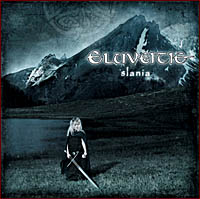
Label : Nuclear Blast / Pias
Sortie du Scud : 15 février 2008
Pays : Suisse
Genre : Folk Metal
Type : Album
Playtime : 12 Titres - 48 Mins
Après la déception rencontrée avec LETZTE INSTANZ concernant le Folk Metal, j’ai toujours eu l’espoir de tomber que quelque chose qui me plairait dans le genre et qui répondrai à mes attentes. Je crois que j’ai trouvé ce que je recherchais avec ELUVEITIE. Ce groupe helvète mélange habilement un Metal lourd et énergique à la fois avec des instruments traditionnels comme la flûte, la cornemuse ou encore la vieille à roue, entre autre. Le mélange peut paraître surprenant, mais on sait que le Metal se marie fort bien avec toute sorte de musiques, et la musique folklorique, ici plutôt celte, n’échappe pas à la règle. Cela coule même de source. Et on s’en rend compte dés le premier titre, « Samon », qui fait office d’introduction instrumentale. Les autres titres sont une alternance entre des rythmiques rapides (« Bloodstained Ground ») ou plus posée (« Inis Mona »). Mais on sent toujours cette recherche permanente de la meilleure adéquation entre puissance, violence et musicalité plus classique.
On trouve même un morceau sans l’ombre d’une instrumentation électrique, « Anagantios ». Ce titre est très beau, même si un peu répétitif dans ses schémas. Il suit un peu le principe d’un boléro de Ravel qui utilise la même structure en faisant entrer des instruments différents à chaque nouvelle reprise. Et puis il y a le plus calme « Slanias Song » avec un chant féminin envoûtant alors que les voix féminines sont plus des chœurs sur les autres morceaux.
Le titre « Inis Mona » fait un peu office de figure de proue sur ce Slania. Il est taillé pour plaire et pour démontrer ce que le groupe sait faire. Ce n’est d’ailleurs pas pour rien que la mélodie principale des instruments folkloriques est celle de la chanson « Tri Martelod » qui avait été popularisée par ALAN STIVELL puis repris en grande pompe par le groupe de Rap MANAU il y a quelques années de cela. Et on sait toute l’efficacité que cette mélodie peut avoir.
Tous les titres de cet album sont de bons titres en soi. Le seul bémol que je mettrais est que, sur la longueur, le disque peut être un peu lassant, puisqu’on retrouve souvent les mêmes schémas musicaux et la même manière d’utiliser les violons et autres flûtes. Certes, c’est ce qu’il se passe aussi dans la musique dont ELUVEITIE s’inspire, mais cela rend le disque plus difficile à écouter d’un bout à l’autre. Mieux vaut y piocher des extraits de temps en temps, parce qu’ils sauront alors vous satisfaire, que de vous gaver jusqu’à l’écœurement.
Ajouté : Vendredi 25 Janvier 2008 Chroniqueur : Wong Li Score :     Lien en relation: Eluveitie Website Hits: 15579
|